
Phoenix Water Damage Restoration in Jersey City: A Homeowner’s Guide
Plaster walls can hold three times the moisture of drywall before they feel damp to the touch, which means a Jersey City brownstone can look fully dry on the surface while the lath behind it is already growing mold. Most water damage in Jersey City homes isn’t the dramatic kind you see on the evening news. It’s the slow, silent kind that hides behind pre-war walls and under old floorboards until the damage is far worse than it needed to be. This guide maps the specific places water goes to hide in Jersey City’s older homes and what a complete restoration actually looks like from floodline to finished wall.
If you’d rather not sort through moisture maps and drying logs yourself, call us at (640) 400-9404 for a free estimate. We’ll send someone who knows these buildings.
Why Jersey City’s Older Homes Hide Water Differently
A 1920s brownstone in Bergen-Lafayette or a pre-war row house in the Heights doesn’t dry out the way a 2005 subdivision house does. The building materials themselves make the difference.
Plaster walls, common in homes built before 1950, hold moisture differently than modern drywall. Plaster is denser and more absorbent. The lath behind it, often wood strips or metal mesh, creates thousands of tiny cavities where water can sit undisturbed. Horsehair insulation, standard in that era, wicks moisture laterally across wall cavities. A leak that starts near a window in a Greenville rowhouse can travel ten feet along the wall before you notice a single stain.
Brick cavity walls, the backbone of Jersey City’s historic districts, add another layer of complexity. Water gets into the cavity between the brick face and the interior wall, then drips down to the sill plate. That sill plate, usually wood, sits directly on the foundation. Once it rots, the structural damage begins. You won’t see it from inside. You won’t see it from outside. You’ll only find it when a moisture meter reads elevated levels at the base of the wall, which is exactly where a thorough Jersey City water damage inspection starts.
The Intrusion Points Most Checklists Miss in Hudson County
Every restoration company knows to check the water heater, the washing machine supply lines, and the sink traps. The problem in Jersey City is that the biggest risks aren’t in your unit at all. They’re in the shared infrastructure.
Shared plumbing stacks run vertically through stacked condos and converted brownstones throughout downtown Jersey City and Journal Square. When a stack fails on the third floor, water travels down through the walls of the second and first floors before pooling anywhere visible. By the time you see it, you’re dealing with water that has passed through multiple wall cavities, picking up dust, debris, and whatever else it touched along the way.
Party walls, the shared walls between rowhouses, create the same problem horizontally. A leak in your neighbor’s bathroom can saturate the wall cavity you share, warping your plaster and feeding mold on your side of the property line. Flat-roof drainage failures are the third Hudson County classic. Torch-down and rubber membrane roofs on older Jersey City buildings clog with leaves, pool water at the scuppers, and eventually find a seam. That water then drops into the top-floor ceiling cavity and works its way down.
None of these show up on a generic checklist. They require a restoration team that knows Jersey City’s building stock specifically, like our team at Water Damage Restoration in Jersey City.
What a Moisture Log Is and How to Read It
The single most useful document in any water damage restoration is the moisture log. This is a running record of moisture readings taken at specific locations throughout the drying process. Most homeowners never see one, and that’s a mistake.
A proper moisture log shows three things: the location of each reading, the date and time it was taken, and the moisture content percentage at that location. The dry standard for wood in the Northeast is typically between 8% and 12% moisture content, depending on the wood species and the time of year. Plaster and masonry have their own standards, and a competent restoration crew knows the difference.
Here’s what to look for before you sign any completion paperwork:
- Daily readings, not weekly. Professional-grade drying equipment changes conditions fast. Readings should be logged every day the equipment runs.
- Consistent locations. The same wall, the same stud, the same floor section should be measured each time. If a reading jumps around, the log is useless.
- Downward trend. Moisture readings should decline steadily as drying progresses. Flat readings for several days mean the drying isn’t working.
- Final numbers below the dry standard. If the last reading on your log says 14% on a wood floor, the job isn’t done, no matter what the crew says.
We hand the moisture log to every homeowner and their insurance carrier at the end of every job. You should accept nothing less.
Why Splitting Extraction from Rebuild Creates a Gap You Pay For
Here’s a scenario we’ve seen repeatedly across Jersey City. A pipe bursts in a Paulus Hook condo. The insurance company sends one company to extract the water and run fans for three days. That company declares the unit dry and leaves. A second company comes in to rebuild the drywall, sand the floors, and repaint. Six months later, the homeowner notices a musty smell near the baseboard. The first company says their moisture readings were fine. The second company says the first company didn’t dry it properly. The insurance carrier says the claim is closed. The homeowner is left holding the bill.
This is the liability gap created when extraction and reconstruction are handled by separate companies. Each company only owns their piece of the job. Neither owns the outcome. When something goes wrong, they point fingers at each other, and the homeowner becomes the messenger between two contractors and their insurance carrier.
At Floodline Restoration Co., the same certified crew handles everything from the first extraction to the finished wall. That means one team owns the entire job, one team is accountable for the final condition of your home, and one team’s guarantee covers the whole scope of work. When you call for Floodline Restoration Co. home, you get the whole job handled by people who have been doing this in Jersey City since 2010, led by Curt Bowman.
We pulled one out of a garage over in the Heights last year where the homeowner had paid another company to dry a flooded basement. The company ran box fans for two days and called it done. When we opened the wall six months later, the sill plate was so rotted you could push a screwdriver through it with one hand. The drying log didn’t exist. The rebuild company wouldn’t touch it without a new scope. That homeowner paid twice for the same job because no single company owned the result.
The 90-Day Window: What Incomplete Drying Actually Looks Like
The first 90 days after a water damage restoration are when incomplete work shows itself. The signs aren’t always dramatic. Often they’re subtle enough that homeowners talk themselves out of taking action.
What to watch for in the three months after any water damage job in Jersey City:
- A musty or earthy smell, especially near baseboards or in closets. This is the first sign of mold growth behind walls.
- Cupping or crowning in hardwood floors. Cupping is when the edges of floorboards rise above the center. Crowning is the opposite. Both mean the wood wasn’t dried to the right moisture content before refinishing.
- Paint bubbling or peeling in areas that were supposedly dried completely.
- Doors or windows jamming that opened fine before, a sign the framing has absorbed moisture and swelled.
- Efflorescence, the white powdery deposit on concrete or masonry, which means water is still moving through the material.
Any one of these signs warrants a call back to the restoration company. The 90-Day Done Right Promise, the Keystone Standard we give in writing with every job, means if it’s not done right, we make it right. No arguing, no paperwork battles. That’s the kind of guarantee that has real teeth, and it’s exactly what you should demand from any restoration company working in your Jersey City home.
When to Call a Professional
Water damage restoration is not a DIY project when the water has reached any of the hidden zones described above. If water has touched a wall cavity, a stair stringer, a sill plate, or any enclosed space you can’t see into, you need professional-grade equipment and trained technicians who know how to use it.
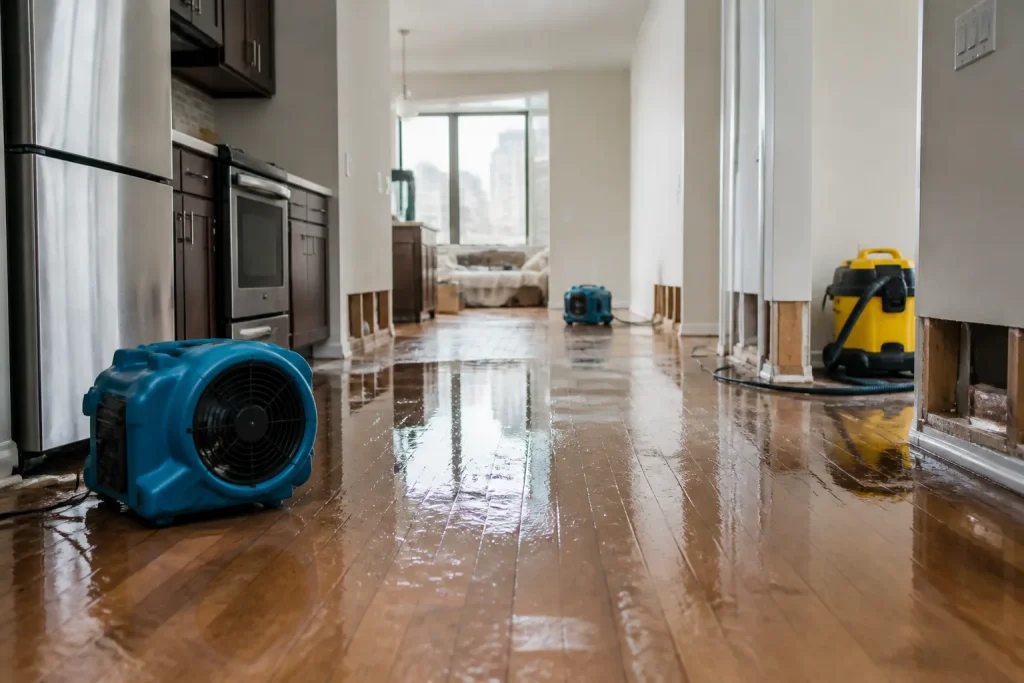
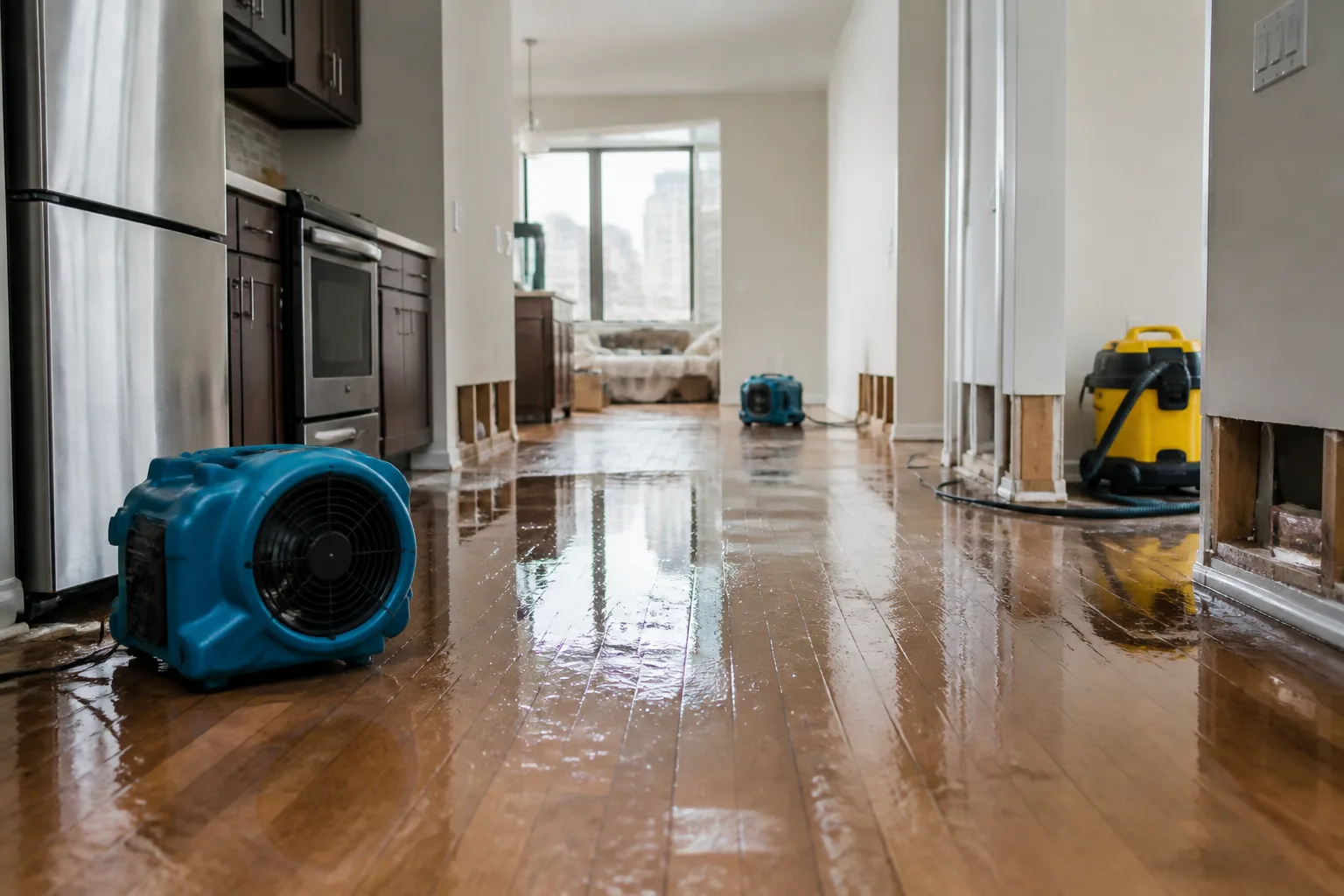
That means Dri-Eaz dehumidifiers, Phoenix axial fans, and moisture meters that read deep into materials, not just the surface. It means technicians certified to IICRC, RIA, and IFA standards who know how to place equipment for maximum drying efficiency. It means a written drying plan with daily moisture readings until the dry standard is met. Our crews use professional-grade Dri-Eaz and Phoenix equipment on every job, and most jobs are completed in a single visit because the same crew that reads the moisture map on day one handles daily readings and rebuilds what needs rebuilding.
For homeowners dealing with mold that’s already taken hold, see our Mold Remediation in Jersey City page. If you’re facing the aftermath of a kitchen or electrical fire, our Fire & Smoke Damage Restoration in Jersey City team handles that as well.
The Bottom Line
Water damage in Jersey City’s older homes hides in places modern construction never has to worry about. Plaster and lath walls, brick cavity walls, horsehair insulation, shared plumbing stacks, party walls, and flat-roof drainage failures all conceal moisture long after the surface looks dry. A complete restoration means locating every hidden pocket of water, drying it to the documented dry standard, and standing behind the work in writing.
If you’re in Jersey City and need help, Floodline Restoration Co. offers free estimates. We’ve been serving Jersey City since 2010, with live phone dispatch 24 hours a day, 7 days a week. Call (640) 400-9404 and a live person will answer, not a recording. We’ll send a certified, background-checked crew to your home, and we’ll hand you a complete moisture log with the 90-Day Done Right Promise when the job is finished.
Frequently Asked Questions
Water damage restoration in Jersey City typically ranges from $2,500 for a contained leak with minor drying to $15,000 or more for multi-room flooding in older homes with plaster walls and hardwood floors. The final number depends on the extent of the damage, how long the water sat, and whether rebuild is required. Call (640) 400-9404 for an exact quote, estimates are free with no obligation.
Most homeowner policies in Jersey City cover sudden and accidental water damage, such as a burst pipe or an overflowing appliance. Gradual leaks and flood damage from outside water are typically excluded unless you carry separate flood insurance. We bill your carrier directly and send photo documentation of every stage of the job to your adjuster, so you never play messenger between us and the insurance company.
Our live dispatchers answer the phone 24 hours a day, 7 days a week. In most cases, a certified crew reaches your Jersey City home the same day you call, and extraction is running during that first visit. The speed matters because water wicks deeper into plaster walls and under floors with every hour it sits. Call (640) 400-9404 the moment you see water, even if it’s 2 a.m.
Surface drying with box fans rarely works in Jersey City’s older homes because plaster and lath walls hold moisture far below the surface. What looks dry on the outside can still be wet behind the wall, and that trapped moisture feeds mold and rots structural wood. Professional restoration uses moisture meters to find every hidden pocket of water and commercial-grade equipment to dry it to the documented dry standard. A moisture log proves the job is actually done. Anything less is a gamble you’ll pay for later.
We do. Floodline Restoration Co. documents every job with photos, moisture readings, and a written scope of work, then sends all of it directly to your insurance carrier. We bill the carrier directly for covered work, which means you’re not fronting money out of pocket. If the adjuster has questions, we answer them. You signed up for a restoration, not a second job as a claims processor.
Written by Curt Bowman, Owner at Floodline Restoration Co., serving Jersey City since 2010.
Need Damage Restoration Help?
Call Floodline Restoration Co. - licensed & insured, here with fast after-hours help in Jersey City.
(640) 400-9404