
Last updated August 25, 2026
Free visual inspection and a written scope of work before any mitigation begins - photos, moisture readings, and drying logs go in your claim file
The scope we write is the scope we bill. Anything new gets shown to you, in writing, before we touch it.
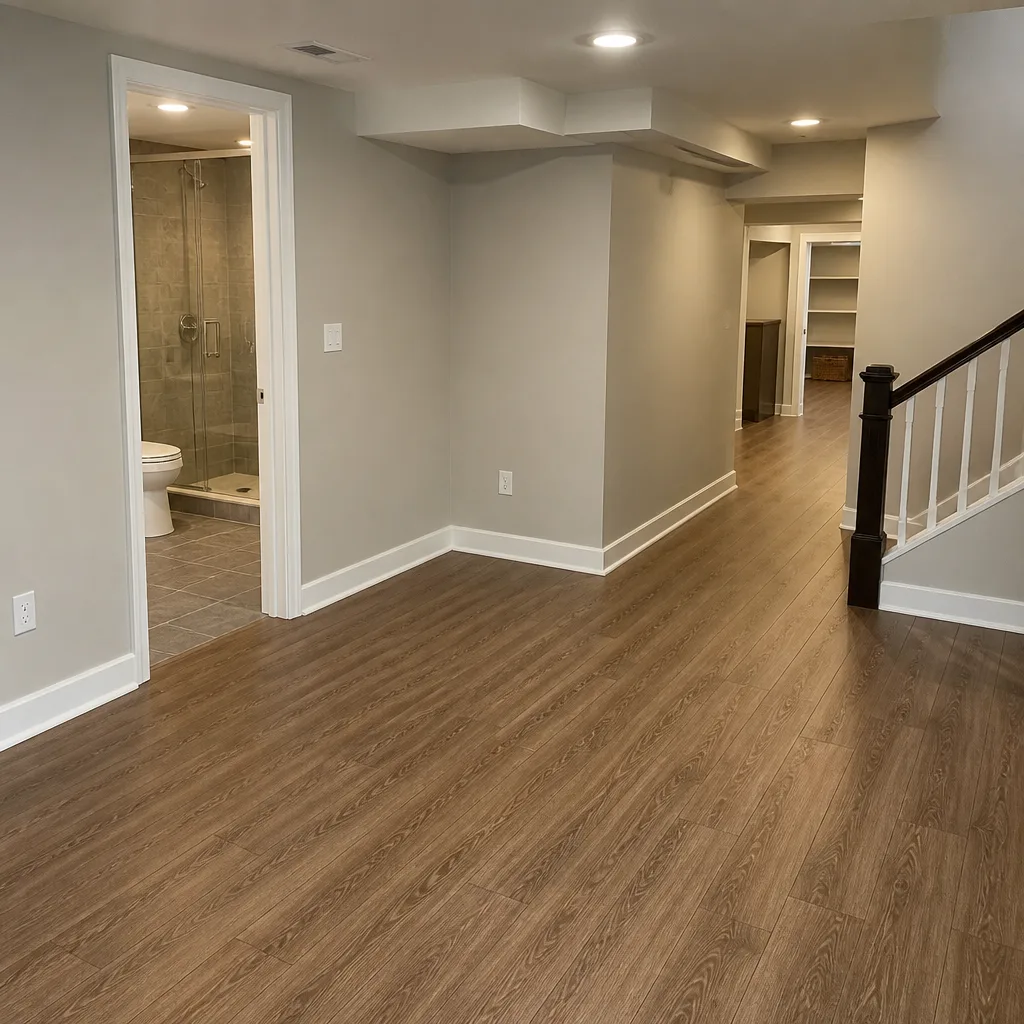

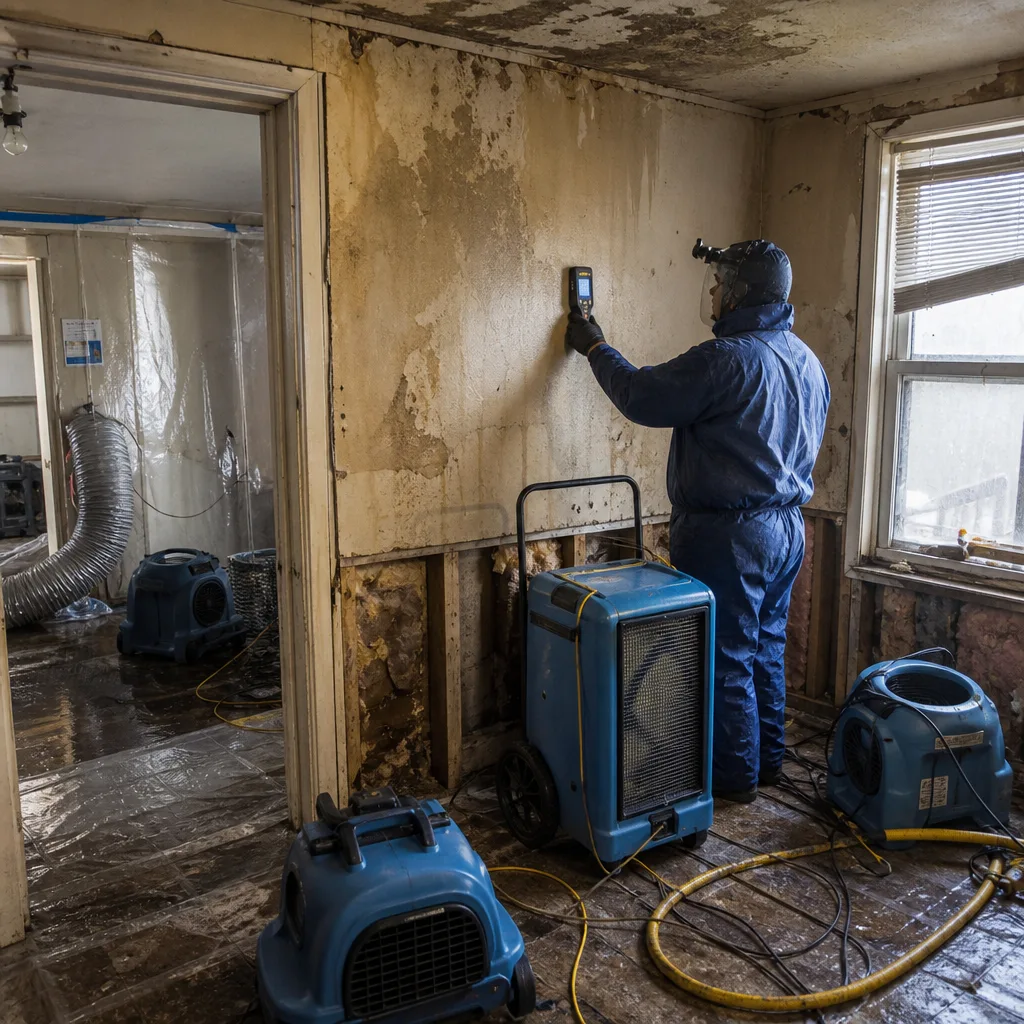 Before
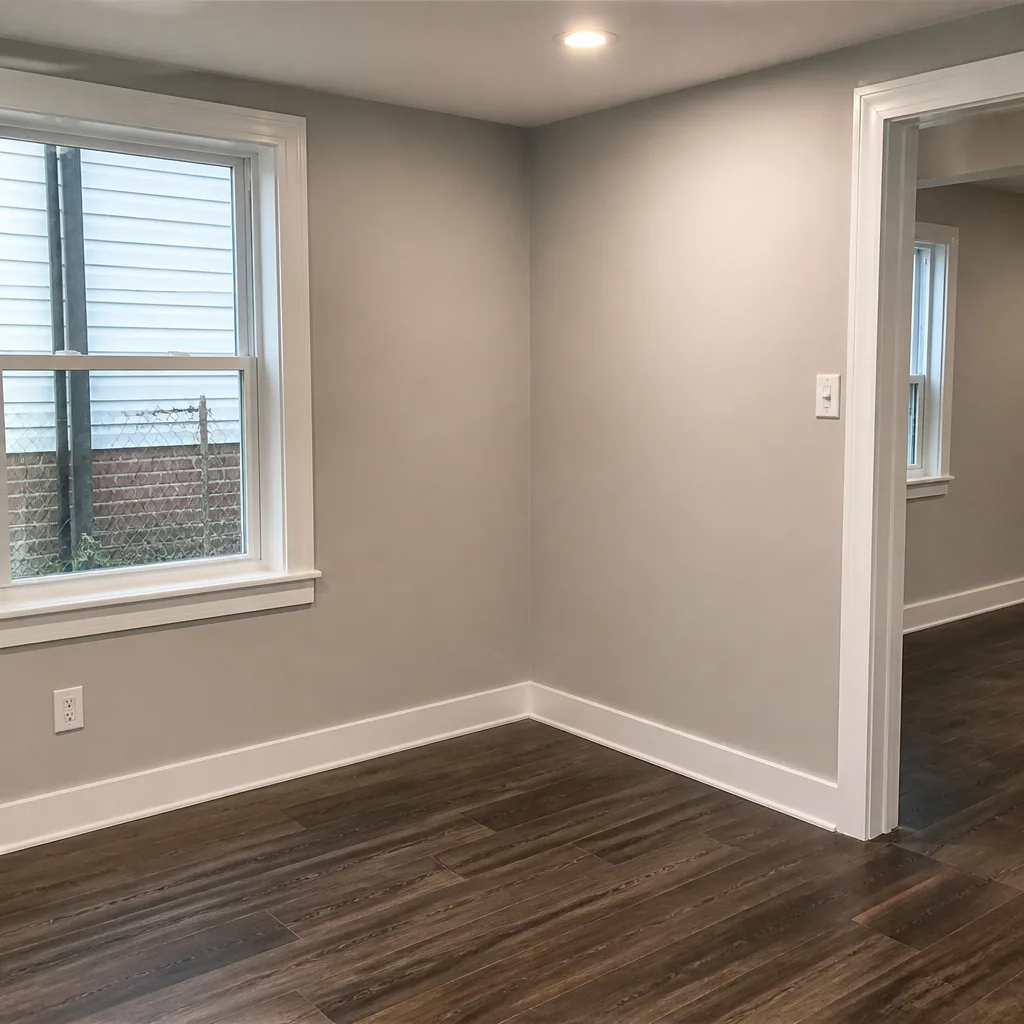 After
After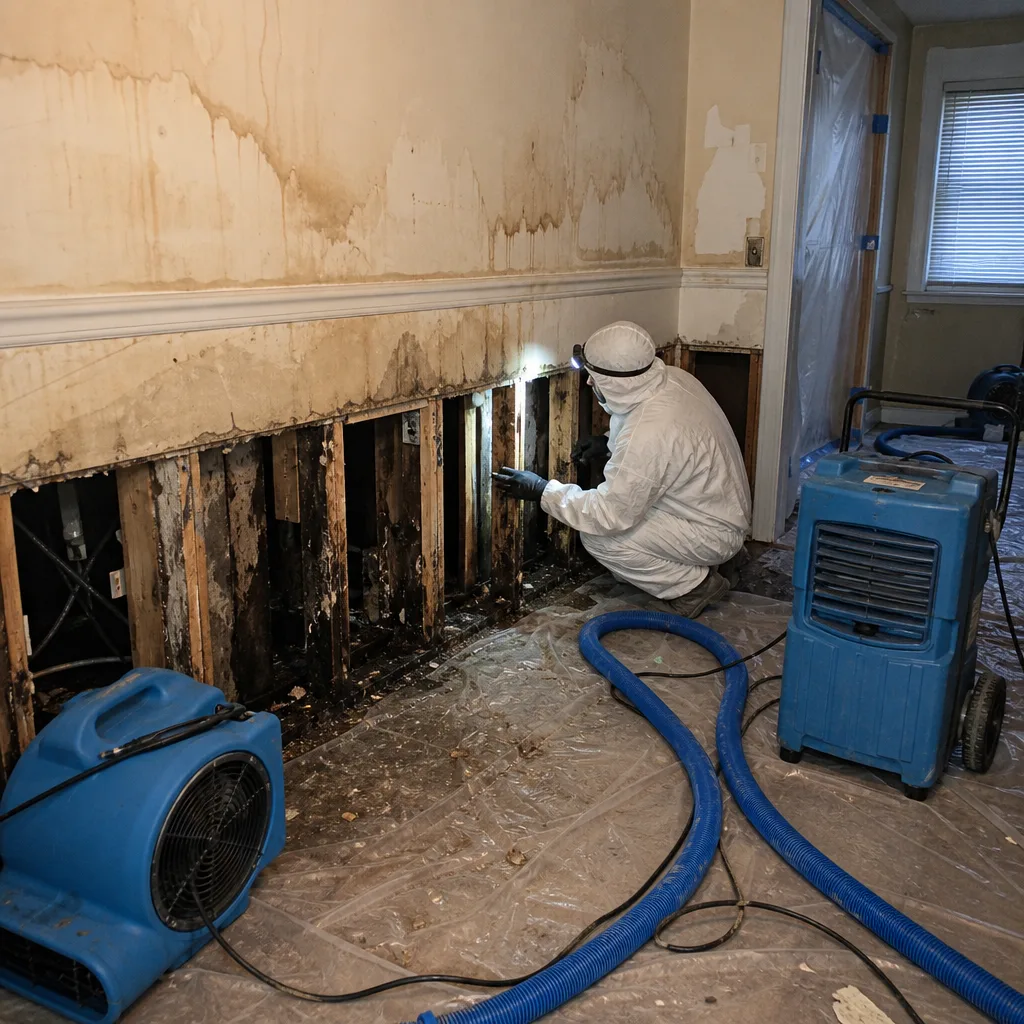 Before
 After
After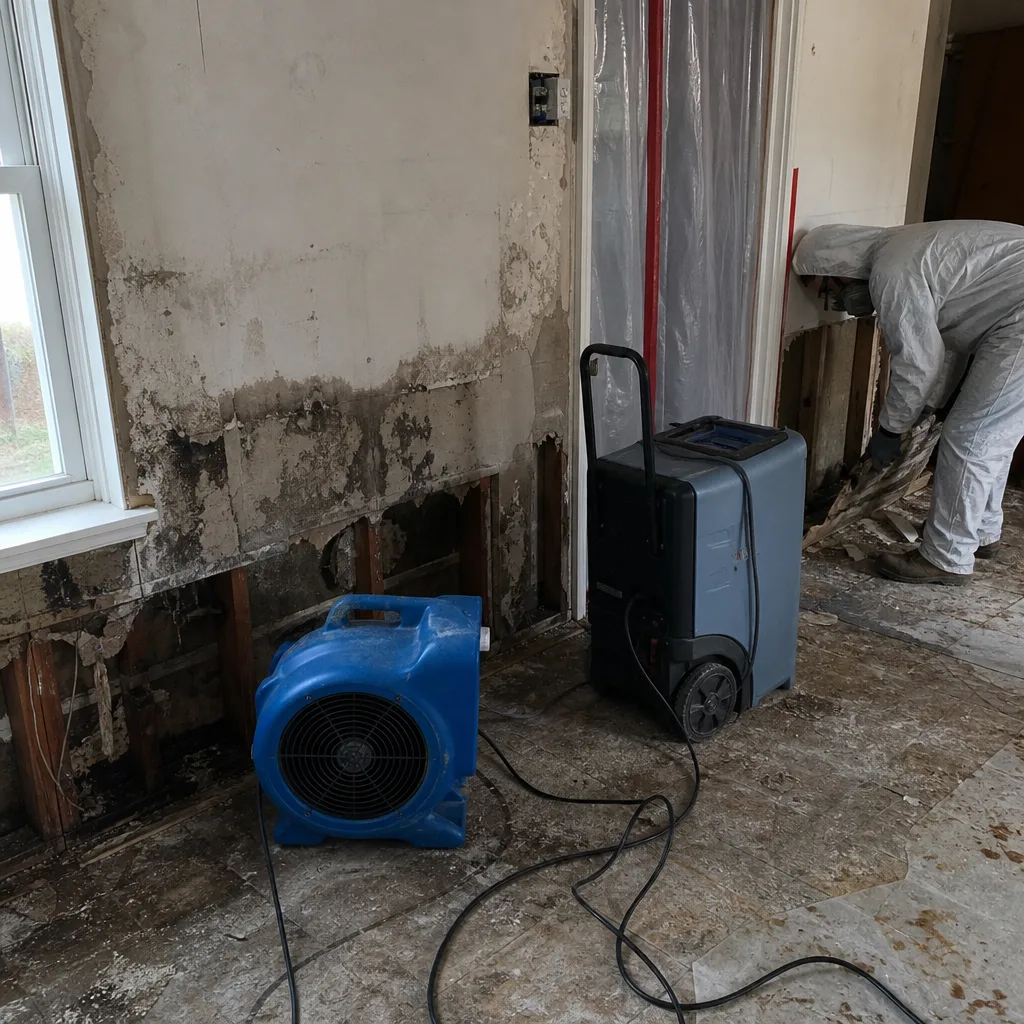 Before
 After
AfterDIY vs Professional Damage Restoration: The Jersey City Homeowner’s Decision Guide
Most Jersey City homeowners who attempt their own water damage restoration end up spending more than if they had called a professional on day one. It’s the hidden costs that get you: the moisture trapped behind baseboards you never saw, the mold that blooms three weeks later, the insurance claim denied because the documentation didn’t meet the carrier’s standard. This guide walks through exactly what DIY can handle, what it cannot, and where the line sits for homes in Jersey City specifically. You’ll learn what professional-grade drying actually involves, what restoration costs in this market, and how to decide before the damage spreads.
Quick Answer
For anything beyond a small, contained spill that you can dry completely within 24 hours, professional restoration is the safer and usually cheaper choice in Jersey City. Water, mold, and fire damage hide in places homeowners cannot see or access, and incomplete drying leads to structural rot and mold that costs far more to fix later. If the affected area is larger than a bath mat, or the water came from a sewage line, a sump failure, or a roof leak that soaked through insulation, call a certified restoration crew.
Table of Contents
- What DIY Can Actually Handle
- What DIY Cannot Handle
- The Hidden Costs of DIY Restoration
- Jersey City Specific Factors
- Cost Comparison: DIY vs Professional
- The Equipment Reality Check
- Insurance and DIY: What You Need to Know
- Common Mistakes to Avoid
- When to Call a Professional
- Frequently Asked Questions
- The Bottom Line
What DIY Can Actually Handle
Let’s be honest about where DIY works. There are situations where a homeowner with a wet vac, some towels, and common sense can fully resolve the problem without professional help. The key word is fully. If you can see the entire affected area, dry it within a day, and confirm with your own eyes that nothing wicked into a wall cavity or under flooring, you’re probably fine.
Here’s the checklist for a DIY-appropriate situation:
- The water is clean. It came from a supply line, a faucet, or a glass knocked over. If it’s from outside flooding, a sewer backup, or a toilet overflow, DIY is the wrong call. Sewage and stormwater carry bacteria and pathogens that require professional-grade antimicrobial treatment and proper disposal protocols.
- The area is small and visible. A kitchen floor tile section, a hallway, a bathroom floor. You can see the full perimeter of the wet area and confirm water did not run under cabinets or appliances.
- The surface is non-porous or easily dried. Tile, vinyl, concrete, or sealed hardwood. Carpet with a pad underneath is a different story: water wicks into the pad and stays there, and a household fan will not reach it.
- You caught it immediately. Water that has been sitting for less than a few hours has not yet begun to migrate into drywall, baseboards, or subfloor. After 24 hours, the window for DIY has closed because mold spores activate and structural materials begin to wick moisture upward.
When these four conditions are met, a homeowner can extract the water with a wet vac, run fans and a dehumidifier for 24 to 48 hours, and monitor the area. In Jersey City’s older housing stock, though, that last condition trips people up. Many homes in Bergen-Lafayette, Greenville, and The Heights have plaster walls and wood lath construction that absorbs water differently than modern drywall. Plaster can look dry on the surface while holding moisture underneath for weeks. Our crews have pulled baseboards in Jersey City homes and found water that had traveled six feet from the original spill along the bottom plate of a wall, invisible the entire time.
Here is a simple numbered process for a small, contained spill you are confident you can handle:
- Stop the source of water first. Shut the valve, turn off the appliance, or contain the leak.
- Extract as much water as possible with a wet vac or towels. Do not use a household vacuum cleaner.
- Remove any soaked rugs, cushions, or movable items and set them outside or in a ventilated area.
- Run a box fan or oscillating fan pointed at the wet area, plus a household dehumidifier if you own one.
- Check the area every 12 hours for 48 hours. If it is not bone dry by then, call a professional. The window for preventing mold is closing fast.
What DIY Cannot Handle
The line between DIY and professional territory is drawn by three factors: the volume of water, the category of water, and the material it soaked into. Cross any one of these lines and you are no longer making a judgment call; you are gambling with your home’s structure and your family’s health.
Category 2 and Category 3 water. The restoration industry classifies water damage into three categories. Category 1 is clean water from a supply line or faucet. Category 2, or gray water, includes washing machine overflow, dishwasher discharge, and sump pump failures that mix with soil or detergent. Category 3, or black water, is sewage, storm surge, river flooding, or any water that has been sitting long enough to grow bacteria. Category 2 and 3 water requires extraction, disposal of contaminated materials, and application of EPA-registered antimicrobial agents by someone who knows how to handle them safely. This is not a fan-and-towel situation. The health risk from airborne pathogens and the contamination spread into porous materials is real and documented. Our technicians are trained to IICRC standards for exactly this reason, and they wear proper PPE, contain the area, and dispose of contaminated materials according to local Jersey City waste regulations.
Water behind walls or under floors. Once water migrates out of sight, you need two things a homeowner does not have: a moisture meter and an infrared camera. In our experience with Jersey City homes, water from a second-floor bathroom leak often travels down inside the wall cavity and pools at the first-floor ceiling, then runs along joists into rooms the homeowner never connected to the original leak. Without moisture mapping, you are guessing. Guessing wrong means you seal up a wall with water still inside, and six months later you’re looking at black mold and rotted studs.
Mold beyond a small spot. If you see mold on a surface larger than about ten square feet, the EPA itself recommends professional remediation. The reason is containment: disturbing mold releases spores that spread through the HVAC system and into rooms that were previously unaffected. Professional mold remediation in Jersey City requires containment barriers, negative air pressure, HEPA filtration, and proper disposal. A homeowner with bleach and a sponge can turn a small problem into a house-wide contamination event. Bleach, by the way, does not kill mold on porous surfaces like drywall or wood. It only bleaches the surface while the roots remain alive underneath.
Fire and smoke damage. After a fire, the visible char is only part of the story. Smoke penetrates every porous surface: drywall, insulation, carpet, upholstery, clothing. The acidic soot residue begins etching surfaces within hours. Restoration requires specialized cleaning agents, ozone or hydroxyl treatments, and often full replacement of insulation and drywall sections. A Jersey City homeowner in a multi-family building also faces the reality of shared walls: smoke travels through shared ventilation and between wall cavities, meaning the damage is rarely contained to one unit.
The Hidden Costs of DIY Restoration
When homeowners compare DIY costs to professional restoration, they usually compare the visible line items: a wet vac rental versus a restoration company’s quote. That comparison misses the expensive parts. Here is what DIY actually costs when it goes wrong, and it goes wrong more often than not in our experience with Jersey City homes.
The mold you did not find. A dehumidifier from Home Depot and a couple of box fans cannot dry a wall cavity or a subfloor. Those spaces hold moisture for weeks, and mold colonies establish themselves in 24 to 48 hours. Remediation of mold that grew because of incomplete DIY drying typically costs between $1,800 and $6,000 in Jersey City, depending on the extent. That is on top of whatever you already spent on your DIY attempt.
The insurance claim that got denied. Insurance carriers require documentation. They want photos of the initial damage before anything was touched, a moisture log showing daily readings, an itemized list of affected materials, and a clear chain of evidence from cause to remediation. Homeowners doing their own restoration rarely produce documentation that meets carrier standards. When a claim is denied or reduced because of insufficient documentation, the homeowner eats the entire cost, including the damage that professional mitigation would have prevented. Floodline Restoration Co. bills carriers directly and provides photo-documented assessments and daily moisture logs specifically because we know what adjusters look for. It is not paperwork theater; it is the difference between a covered claim and a denied one.
The structural damage that built up over months. Wood rot in floor joists, sill plates, and wall studs does not happen overnight. It happens when moisture sits in contact with wood for weeks or months. A homeowner who dried the surface but missed the water that wicked into the subfloor will discover the rot eventually, often when a floor feels soft or a wall starts to bow. Replacing structural framing in a Jersey City rowhouse or brownstone is not a weekend project. It is a structural repair that requires a building permit in many cases and can run into five figures.
The health costs. We do not want to be alarmist, but the health effects of indoor mold exposure are well documented. Respiratory issues, allergic reactions, asthma exacerbation, and chronic sinus problems are linked to prolonged mold exposure in indoor environments. Older adults, which describes a large share of Jersey City’s long-term homeowners, are especially vulnerable. The cost of DIY is not just measured in dollars; it is measured in wheezing, headaches, and sleepless nights in a house that never got truly dry.
Lost time. Restoration is not a two-hour job. A proper professional dry-down of a moderate water event takes three to five days of equipment runs, daily moisture readings, and adjustment. Most Jersey City homeowners have jobs, families, and lives. Spending a week babysitting fans and emptying dehumidifier buckets is its own cost, and it is one you pay while the damage continues to progress.
Jersey City Specific Factors That Make DIY Harder
Jersey City is not a generic suburb. Its housing stock, climate, and infrastructure create specific challenges that make DIY restoration riskier here than in many other places. We have been working in Jersey City since 2010, and these are the factors we deal with on a weekly basis.
The housing stock is old. A large share of Jersey City homes were built before 1950. That means plaster walls, balloon framing, original hardwood floors, and construction methods that respond to water very differently than modern materials. Balloon framing, common in older Jersey City homes, allows water to travel vertically through wall cavities from a leak on the third floor all the way to the basement with nothing in between to stop it. In one home in The Heights, a roof leak had traveled three full stories before we found the moisture in the basement ceiling. A homeowner looking only at the attic would have missed it entirely.
Multi-family density. Jersey City is dense. Rowhouses share party walls. Condos and co-ops share floors, ceilings, and ventilation. Water damage in one unit rarely stays in one unit. A leak from a third-floor bathroom in a brownstone on Paulus Hook can affect the two units below it. DIY restoration in a multi-family building is not just a personal choice; it often affects neighbors, and it implicates condo association rules and shared insurance policies. Professional restoration companies coordinate with building management and neighbors because they have done it hundreds of times.
The climate works against you. Jersey City has high humidity for much of the year, especially from July through September. High ambient humidity slows evaporation and extends drying times. A fan that would dry a floor in 24 hours in Arizona takes 48 hours or more in a Jersey City July. Worse, the humidity itself creates secondary damage: materials that stay damp longer become more hospitable to mold. Professional drying relies on equipment designed to pull moisture out of the air and materials simultaneously, with daily adjustments based on changing conditions.
Flooding is a recurring reality. Parts of Jersey City, particularly areas near the Hackensack River, the Hudson River, and low-lying neighborhoods like Country Village and sections of Greenville, have real flood exposure. Storm surge, heavy rain events, and aging drainage infrastructure all contribute. Floodwater is always Category 3 water: it carries sewage, chemicals, and debris. DIY flood restoration is not safe, full stop. The contamination alone requires professional handling, and the drying challenges in a flooded basement in Jersey City are substantial.
Cost Comparison: DIY vs Professional in Jersey City
Let’s talk numbers. These are the costs we see in the Jersey City market as of 2026. Your specific situation will vary, but these ranges reflect what homeowners in this area can expect.
| Scenario | DIY Estimated Cost | Professional Estimated Cost | Notes |
|---|---|---|---|
| Small clean water spill (under 10 sq ft, caught immediately) | $75-$200 | $350-$650 | DIY is reasonable if you can dry it within 24 hours and the water did not reach walls. |
| Moderate water leak (supply line, one room saturated) | $200-$500 (rental equipment, materials) | $1,200-$4,500 | Professional cost includes extraction, drying, monitoring, and documentation. DIY risk: hidden moisture and mold. |
| Sewage backup or Category 3 water | Not recommended at any price | $2,500-$9,000+ | Professional cost includes containment, disposal, antimicrobial treatment, and verification. DIY is a health risk. |
| Mold remediation (visible mold 10-50 sq ft) | $50-$300 (DIY products, usually ineffective) | $1,800-$6,000 | DIY mold removal without containment spreads spores. Professional remediation includes negative air and HEPA filtration. |
| Fire and smoke damage (single room) | Not realistic | $4,000-$15,000+ | Smoke damage requires professional cleaning agents, odor removal, and often structural replacement. |
These are not offers; they are ranges we see in the field for typical Jersey City homes. Every job is different. The point is that DIY costs are front-loaded and obvious, while professional costs include verification and documentation that protect you from the far larger costs of failure. It’s the same reason you hire a licensed electrician rather than watching a YouTube video: the cost of getting it wrong dwarfs the cost of getting it right the first time.
The Equipment Reality Check
When we tell homeowners that professional drying uses equipment they have never seen, we are not being condescending. The equipment gap is real, and it is the single biggest reason DIY drying fails. Here is what you can rent at a big-box store versus what a restoration company deploys.
Your rental dehumidifier moves maybe 20 pints of water per day out of the air. The professional-grade units we use, from Dri-Eaz and Phoenix, move 100 to 150 pints per day. That is not a small difference; it is a five-to-seven-times difference in drying capacity. A basement that takes a rental dehumidifier a week to dry takes our equipment two days.
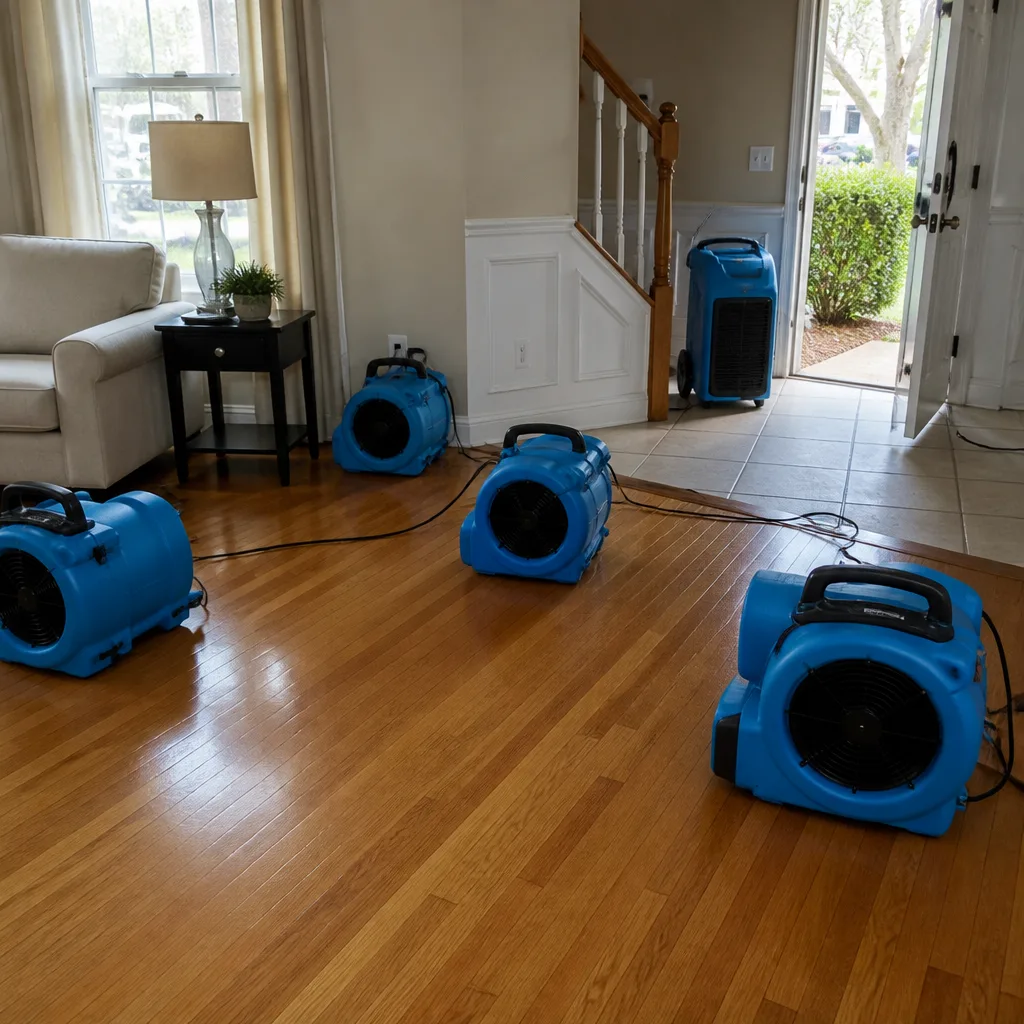
Fans are not all the same. Household box fans move air, but they do not create the high-velocity, focused airflow that professional air movers produce. Proper drying requires directing air along walls, under baseboards, and across surfaces at speeds that force moisture out of materials. Our air movers from Dri-Eaz and XPOWER are designed specifically for this. We also use Injectidry systems that push air directly into wall cavities and under cabinets, spaces no fan can reach.
Moisture meters and thermal imaging are the other half of the job. Drying without moisture readings is like baking without a thermometer: you are guessing. Our technicians use moisture meters to establish a baseline on day one, take daily readings until the dry standard is met, and provide that log to you and your insurance carrier. The log is the proof that the job was done right. Without it, you cannot prove the home is dry, and your insurance company has no documentation to approve your claim.
Air scrubbers and HEPA filtration. When mold is present, or when water damage has the potential to create mold, we deploy air scrubbers that filter the air through HEPA filters. These machines remove airborne spores, dust, and contaminants during remediation. They are not available for rent at Home Depot. Without them, mold spores released during remediation simply settle elsewhere in the home and start a new colony.
The equipment reality is this: professional restoration is not just the same tools you can rent, but bigger. It is a fundamentally different category of equipment, designed for a fundamentally different job. A homeowner with good intentions and rental equipment is like someone trying to put out a kitchen fire with a garden hose. It might work if the fire is tiny and caught immediately. It will not work if the fire has spread, and the cost of finding that out is the house.
Insurance and DIY: What You Need to Know
Most Jersey City homeowners have homeowners insurance, and most policies cover sudden and accidental water damage, fire damage, and often mold remediation when it results from a covered peril. But the way you handle the restoration directly affects whether your claim gets paid, how much gets paid, and how much pushback you get from the carrier.
Documentation is the whole game. Insurance carriers require proof: proof of what happened, proof of what was damaged, proof of what you did about it, and proof that the home was restored to pre-loss condition. Professional restoration companies provide this documentation as a matter of course. We photograph the damage before we touch anything, we create a moisture map on day one, we log daily readings, we itemize every piece of equipment and material, and we hand that packet to the carrier. When you do the work yourself, you are asking the carrier to trust your word, and carriers are institutionally skeptical of homeowner self-remediation. The result is often a reduced payout or a denied claim.
The carrier is not your enemy, but they are not your friend either. Insurance adjusters are trained to protect their company’s money. That is their job. When a homeowner does DIY restoration, the adjuster has grounds to question whether the work was adequate, whether the damage was properly characterized, and whether the costs claimed are legitimate. When a certified restoration company does the work and provides documentation, the adjuster’s job becomes much harder to argue with. The documentation creates a defensible position for the homeowner.
Direct insurance billing changes the dynamic. Floodline Restoration Co. bills insurance carriers directly. That means you are not writing a check and waiting for reimbursement. It also means the carrier is dealing with us, not with you as an intermediary. We know what information they need, we speak their language, and we push back when a carrier tries to lowball a legitimate claim. The homeowner who does DIY is now both the contractor and the claimant, and they are arguing with a professional negotiator who does this every day.
What your policy probably covers. Most standard homeowners policies cover sudden water damage from things like burst pipes, appliance failures, and roof leaks. They typically do not cover gradual damage from long-term leaks, flood damage from external flooding (that requires a separate flood insurance policy through NFIP), or mold that results from neglect. The distinction between sudden and accidental versus gradual matters a lot, and a restoration company that knows how to document the cause in a way that aligns with policy language can make a meaningful difference in your coverage.
Common Mistakes to Avoid
- Using a household vacuum to extract water. A standard vacuum cleaner is not designed for liquids and will short out, potentially causing electric shock or fire. Use a wet vac or call a professional.
- Sealing up walls before they are dry. We see this in Jersey City constantly: a homeowner patches a leak, repaints the wall, and calls it fixed. The moisture inside the wall cavity has not gone anywhere, and mold is already forming behind the new paint.
- Ignoring the baseboards. Water wicks upward through drywall and into baseboards, where it sits against the wall plate and wicks into the framing. Even if the visible wall looks dry, the baseboard line is where mold starts. In older Jersey City homes with plaster walls, this is especially true.
- Using bleach on mold. Bleach does not kill mold on porous surfaces like drywall and wood. It only bleaches the surface while the mold’s roots remain alive underneath. Professional remediation uses EPA-registered antimicrobial agents and, more importantly, addresses the moisture source that allowed the mold to grow.
- Waiting to see if it dries on its own. It will not. Water in a wall cavity or subfloor does not dry on its own in a Jersey City climate; it just sits there and grows mold. The 24-to-48-hour window for mold prevention is unforgiving.
- Forgetting to document everything. Before you touch anything, take photos. Document the source of the water, the affected areas, the materials involved, and the steps you take. If you do end up filing an insurance claim, this documentation is the difference between a covered loss and a denied one. And if you decide to call a professional, stop what you are doing and make that call first: our documentation starts before anything is moved.
- Underestimating the scope after a sump pump failure. A basement that flooded due to a sump pump failure contains Category 2 water at minimum, and often Category 3 if the sump pit is connected to the sewer line, as many in Jersey City are. Pumping out the water with a rented sump pump does not address the contamination in the walls, the floor, or the air.
When to Call a Professional
If you are standing in a wet room and you are not sure whether to grab a mop or grab the phone, here is the short version. Call a professional if the water is not clean, if the affected area is larger than you can see in one glance, if the water has been sitting for more than 24 hours, if you can smell mustiness or see mold, if the water came from a flood or a sewer backup, or if you just do not want to spend the next week fighting a losing battle against moisture you cannot see. The cost of a professional assessment is minor compared to the cost of getting it wrong, and most legitimate restoration companies, including Floodline Restoration Co., offer free estimates for Jersey City homeowners. Call us at (640) 400-9404 and a live person will answer, day or night. We will tell you honestly whether this is a job you can handle yourself or a job that needs professional equipment and training. That honesty is part of what we have built over 42 years in this business: we do not take jobs that do not need doing, and we do not leave jobs half-finished. The Floodline Restoration Co. home is your starting point for understanding what full-cycle restoration means: extraction, drying, and rebuild handled by the same crew, with the 90-Day Done Right Promise in writing at the end.
Frequently Asked Questions
You can dry a small, contained clean-water spill with fans and a household dehumidifier if you catch it immediately and the water did not reach walls, flooring edges, or cabinets. For anything larger, or any water that has been sitting more than 24 hours, household equipment cannot remove moisture from wall cavities and subfloors, and mold will follow. Call (640) 400-9404 for an honest assessment, free of charge.
Floodline Restoration Co. has live dispatch 24/7, and a real person answers the phone at any hour. For water and sewage emergencies in Jersey City, our goal is to have a certified crew on-site the same day you call, with extraction equipment running on that first visit. For reconstruction and rebuild work, we schedule in advance and provide a written scope and timeline before work begins.
Most standard homeowners policies cover sudden and accidental water damage, such as a burst pipe or appliance failure. They typically do not cover flood damage from external flooding, which requires a separate NFIP flood insurance policy, nor gradual damage from long-term leaks. Floodline Restoration Co. bills carriers directly and provides the photo documentation and moisture logs that adjusters require, so you do not have to play messenger between us and your insurance company.
If visible mold covers more than about ten square feet, the EPA recommends professional remediation. Visible mold is almost always an indicator of a larger colony behind the wall or under the floor, and cleaning only the surface leaves the roots and the moisture source in place. Professional remediation includes containment to prevent spore spread during the work. Call (640) 400-9404 and we will tell you whether you have a clean-up job or a remediation job.
The 90-Day Done Right Promise is our written guarantee: if the restoration work we do is not done right, we make it right, no arguing and no paperwork battles. It is known internally as the Keystone Standard, and it is built on the K.E.Y.S. code: Krafted right, Every time, Your home first, Standing behind it. Every job we do in Jersey City is backed by this guarantee in writing.
Yes, in a few ways that matter. The housing stock here is older, with plaster walls and balloon framing that allows water to travel vertically through wall cavities. The density of multi-family buildings means water damage often affects neighbors and shared walls. The humid summer climate slows evaporation and accelerates mold growth. And parts of Jersey City have real flood exposure near the rivers and in low-lying neighborhoods. Professional restoration companies that work in Jersey City understand these factors; companies that do not will miss things.
The Bottom Line
The decision between DIY and professional restoration comes down to one question: are you willing to gamble your home’s structure and your family’s health on equipment that cannot reach the areas where damage actually hides? For small, contained clean-water spills that you catch immediately, DIY works. For everything else, the math favors calling a professional early, before the damage spreads beyond what you can see. A restoration company brings equipment that dries five to seven times faster than anything you can rent, documentation that satisfies insurance carriers, and training that catches the problems you would miss. In Jersey City, with its old housing stock, dense multi-family buildings, and humid summers, the risks of DIY are magnified. Done right, and backed in writing: that is the standard worth holding out for.
Written by Curt Bowman, Owner at Floodline Restoration Co., serving Jersey City since 2010.