
How to Choose the Right Damage Restoration Company in Jersey City
The right damage restoration company in Jersey City is one that handles every phase of the job with its own certified crew, bills your insurance carrier directly, and puts its guarantee in writing before you sign anything. If you’d rather skip the research and talk to someone who has done this work in Jersey City for over 15 years, call (640) 400-9404 for a free estimate.
Now here’s what most people get wrong, and it costs them real money.
The Split-Contractor Trap That Lives in Jersey City’s Licensing Laws
In New Jersey, a contractor can hold a home improvement license and a mold remediation certification independently. That legal quirk means the company that extracts water from your basement in Jersey City may have zero authority to touch the mold growing behind your drywall two weeks later. You find that out when a second invoice arrives from a company you never hired.
This is the split-contractor trap, and it’s where restoration jobs go sideways. The national mitigation franchises operate on this model almost universally: their crew shows up fast, extracts the water, drops fans, and then hands the rebuild to a local subcontractor whose name you’ve never seen. That handoff creates a documentation gap. The moisture readings from week one live in one company’s files. The rebuild invoice lives in another’s. When your insurance adjuster asks who verified the dry standard before the walls went back up, nobody has a clean answer. A claim that should have closed cleanly gets delayed, reduced, or denied.
We’re structured differently. Our Floodline Restoration Co. home page explains the full-cycle model in detail, but here’s the short version: the same certified crew that reads the moisture map on day one handles the daily readings, hands the log to you and your carrier, and rebuilds what needs rebuilding. No mid-job handoff. No inherited crew. One name accountable for the whole job.
Five Contract-Level Questions to Ask Before You Sign Anything
You can’t judge a restoration company by its marketing. You judge it by what it will put in writing. These five questions expose how a company actually operates before any agreement is signed.
1. Who holds the mold remediation license on this job? Ask for the name on the certification, not the company’s claimed affiliation. In Jersey City, if the crew doing your extraction doesn’t hold that license in-house, you’re looking at a future handoff. Get the answer in writing.
2. Who files with the insurance carrier, you or me? A company that bills you and tells you to chase reimbursement is telling you something about its financial stability and its familiarity with claims. Direct billing means the company has done this enough times to know how carriers actually operate.
3. What triggers a change order? Restoration jobs uncover surprises. Mold behind baseboards. Rotted subfloor under tile. A company that can’t answer this question precisely will define the change order loosely later, when you have no leverage. You want a clear, written threshold.
4. Who is on-site versus subcontracted? Specifically: who holds the equipment, who logs the daily moisture readings, and who shows up for the rebuild. If the answer changes depending on the phase, the job is being split. It’s hidden right there in the answer.
5. What does your written post-completion guarantee actually cover? “We stand behind our work” is not a guarantee. It’s a sentence. Something like our 90-Day Done Right Promise has terms: if it’s not done right, we make it right. In writing. No argument. The Keystone Standard, backed by the K.E.Y.S. values code we built the company on: Krafted right, Every time, Your home first, Standing behind it.
What IICRC S500 Certification Actually Means (and How to Verify It)
The IICRC S500 is the industry’s standard for professional water damage restoration. It’s not a badge a company prints from a template. It means the technician holding it has been trained in the science of drying: psychrometry, evaporation rates, moisture mapping, and the engineering of airflow. In practice, that’s the difference between a crew that sets fans and guesses, and a crew that knows exactly how many days of drying your specific wall assembly needs and can prove it with daily readings.
Here’s what most homeowners in Jersey City don’t know: a company can claim IICRC affiliation when one person in the office has a certification, while the actual technicians in your home hold nothing. That’s why you ask for the individual technician’s certification number, then verify it on the IICRC’s public registry. Any company that hesitates to provide individual credentials is answering your question.
Our technicians are background-checked, uniformed, and certified to IICRC, RIA, and IFA standards. That’s not one cert holder in an office; it’s the standard for everyone who walks through your door in Jersey City. We’re happy to provide individual certification numbers when you call. We expect you to check.
How to Read a Restoration Estimate for Red Flags
Estimates are where a restoration company’s character shows up on paper. Two line items reveal more than any sales pitch.
First red flag: vague line items. “Miscellaneous drying equipment.” “Additional remediation services as needed.” “General labor.” These are blank checks. A legitimate estimate from a company that knows its work specifies the equipment: how many Dri-Eaz dehumidifiers, how many Phoenix air movers, where they’ll be placed, and for how many days. The square deal has details. The vague estimate has a markup hiding inside it.
Second red flag: no moisture log commitment. The estimate should state that daily moisture readings will be logged and provided to you and your carrier until the dry standard is met. If that commitment isn’t in writing, the company is signaling that it will decide when the job is done based on the calendar, not on measured moisture content. That’s how you get mold behind rebuilt walls six months later.
We publish our pricing structure plainly because we’ve seen what happens when companies don’t. A Water Damage Restoration in Jersey City job should include the moisture log commitment as a written line item. If it doesn’t, ask why. The answer will tell you everything.
Why Direct Insurance Billing Signals the Right Kind of Company
Here’s a fact most homeowners don’t learn until after the damage is done: a restoration company that bills you directly and lets you chase reimbursement is testing your patience and your bank account. The money has to move either way. The question is who carries the cash flow risk while the claim processes.
A company that bills the carrier directly is signaling two things. First, it has enough financial stability to float the work while the claim processes. Second, and more importantly, it has enough familiarity with the claims process to know how carriers want documentation organized: photos, moisture logs, line-itemed estimates, daily records. That’s not paperwork; that’s the difference between a claim that closes in weeks and a claim that sits in review for months.
When we handle Mold Remediation in Jersey City, we bill the carrier directly. You never play messenger between us and the adjuster. Photo documentation goes to the carrier on a schedule they understand, because we’ve done it hundreds of times in Jersey City and the surrounding area.
We pulled a job out of a garage over near McGinley Square last winter where the homeowner had hired a mitigation company that billed him directly. The claim was denied on documentation gaps. The moisture log didn’t exist. The rebuild invoice was from a different company. By the time he called us, the mold had spread to the ceiling joists. We fixed it, we billed his carrier directly, and the claim closed. But the whole mess started with a company that didn’t put things in writing and didn’t understand how carriers actually process claims.
Equipment Brands Matter More Than You’d Think
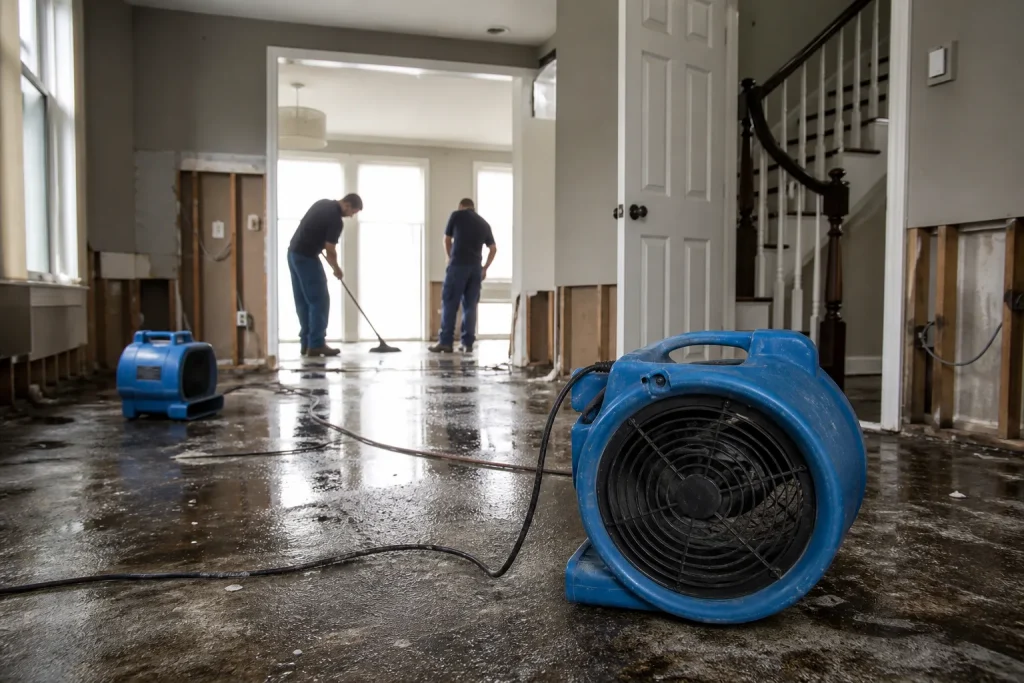
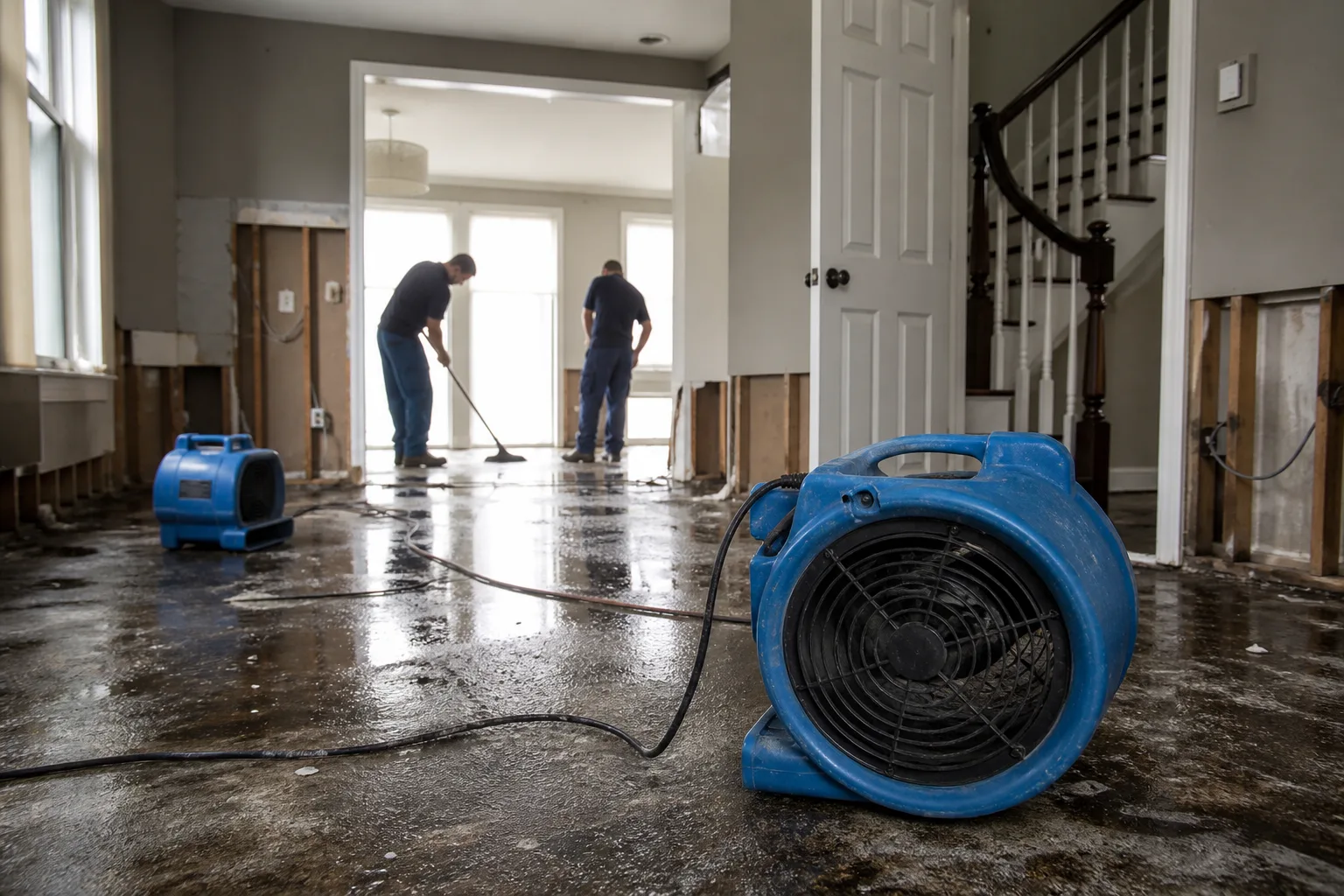
Most homeowners never think about the brand of drying equipment in their home, but it’s one of the quickest ways to tell a serious operation from a corner-cutter. Professional-grade drying equipment moves air differently. A Phoenix air mover isn’t a box fan. A Dri-Eaz dehumidifier isn’t a rental from a big-box store. XPOWER units are built for continuous commercial use over days, not for drying out a basement after a DIY weekend.
Why does that matter to a homeowner in Jersey City? Because drying speed is mold prevention. Every day a wall assembly stays above 16% moisture content is a day mold has to establish. Professional equipment shortens the drying window. Cheap equipment extends it. And extended drying windows are where secondary claims are born.
When you’re comparing restoration companies, ask what equipment they run. If the answer is “industrial-strength drying equipment,” that’s a marketing phrase. If the answer is “Dri-Eaz dehumidifiers, Phoenix air movers, and XPOWER units, moisture-mapped from day one with daily readings logged until the dry standard is met,” that’s a company that knows its work.
When to Call a Professional (and When Waiting Gets Expensive)
Here’s the plain truth: water damage compounds. What starts as a soggy carpet at 8 a.m. becomes saturated drywall by noon and mold by day three. Fire damage leaves smoke residue that etches surfaces within hours. Sewage backups create biohazard conditions that need professional-grade treatment, not a mop and bleach.
If you see standing water, call a professional within the hour. If you can smell mustiness but can’t see the source, call a professional before the problem spreads behind walls. If you’ve had a furnace puff-back or a small kitchen fire, call before you scrub anything; smoke residue sets quickly and becomes harder to remove the longer it sits.
We also handle fire and smoke damage, and the same full-cycle principle applies. See our Fire & Smoke Damage Restoration in Jersey City page for what’s involved there. The important thing is speed: the faster a certified crew is on-site, the less damage there ultimately is to restore.
Red Flags You Can Spot Before You Even Call
Some warning signs show up before a company ever steps foot in your home.
- No live person answers the phone. If you call at 2 a.m. and get a recording, that’s your answer about how they handle emergencies. We have a live dispatcher answering 24/7, every day. A person. Not a phone tree.
- They push a signature before an inspection. Any company that wants a contract signed before it has seen the damage is selling you something other than restoration.
- They won’t discuss pricing ranges over the phone. You should be able to get a straight answer about what a job like yours typically costs.
- The estimate has no equipment specifications. Covered this above, but it bears repeating. No equipment detail, no written moisture log, no deal.
- They badmouth other companies instead of describing their own process. A good company explains how it works. A desperate company explains why its competitors are worse.
The Bottom Line
Choosing a damage restoration company in Jersey City comes down to five written answers: who holds the mold license, who bills the carrier, what triggers a change order, who is on-site, and what the post-completion guarantee covers in writing. A company that answers all five clearly and puts them in writing is a company you can hold accountable. A company that hedges is saying everything you need to know.
We built Floodline Restoration Co. around a simple idea: the line the water left is where we start, and the job isn’t done until the rebuild is finished by the same certified crew, with a moisture log and a written guarantee in your hands. Over 42 years serving local communities, founded in 2010 by Curt Bowman, built around a dispatch board not a sales desk. In Jersey City, we answer the phone with a person at two in the morning, and we’ll be there when we say.
If you’re in Jersey City and need help, Floodline Restoration Co. offers free estimates. Call (640) 400-9404. We’ll give you a square deal and stand behind it.
Frequently Asked Questions
How do I verify a restoration company’s certifications in Jersey City? Ask for the individual technician’s certification number for IICRC, RIA, or IFA credentials, then verify it on the certifying body’s public registry. A company that hesitates to provide individual numbers likely has a company-level claim without technician-level qualifications.
Will my insurance cover water damage restoration? Most homeowners policies cover sudden and accidental water damage, but coverage depends on the source and the policy language. A restoration company that bills the carrier directly and documents the job with photos and moisture logs significantly improves the odds of a clean claim. Call (640) 400-9404 and we’ll walk you through what your policy likely covers in Jersey City.
How fast can a restoration company actually get to my house in Jersey City? A company with 24/7 live dispatch can have a certified crew on-site within hours, not days. Speed matters because water damage compounds by the day, and drying time directly affects mold risk. We answer the phone with a live person at any hour and dispatch immediately.
Do I really need full remediation or just a cleanup? It depends on the water source, the materials affected, and the moisture readings. Clean water on tile is very different from sewage on drywall. The honest answer comes from a moisture map and daily readings, not from a guess. We’ll tell you straight what the scope is, and we’ll put it in writing before any work starts. Estimates are free at (640) 400-9404.
Written by Curt Bowman, Owner at Floodline Restoration Co., serving Jersey City since 2010.
Need Damage Restoration Help?
Call Floodline Restoration Co. - licensed & insured, here with fast after-hours help in Jersey City.
(640) 400-9404