
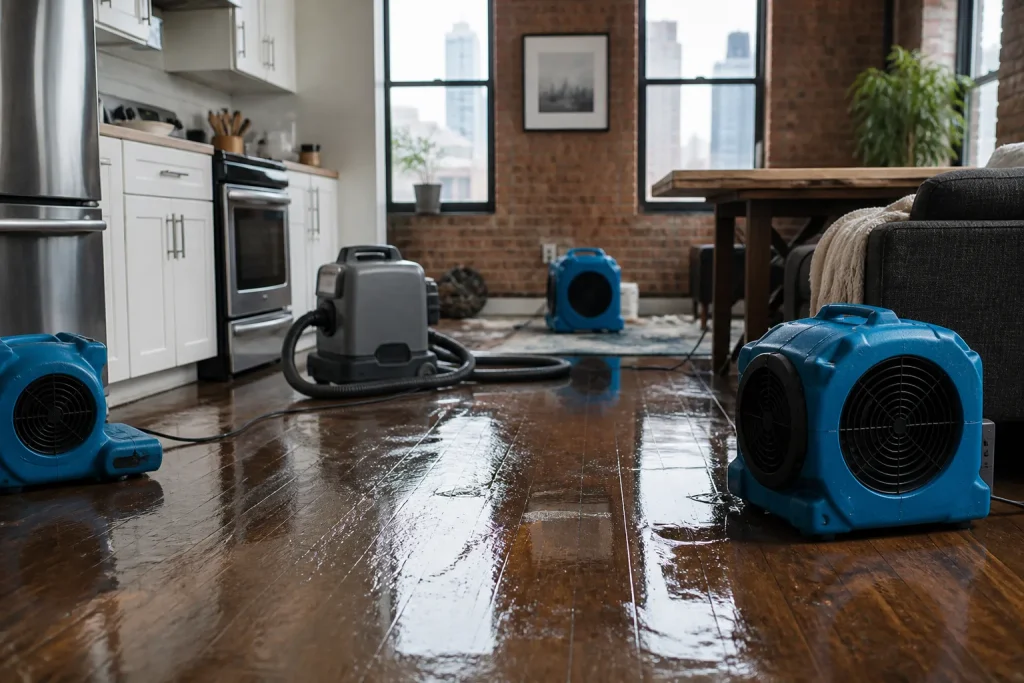
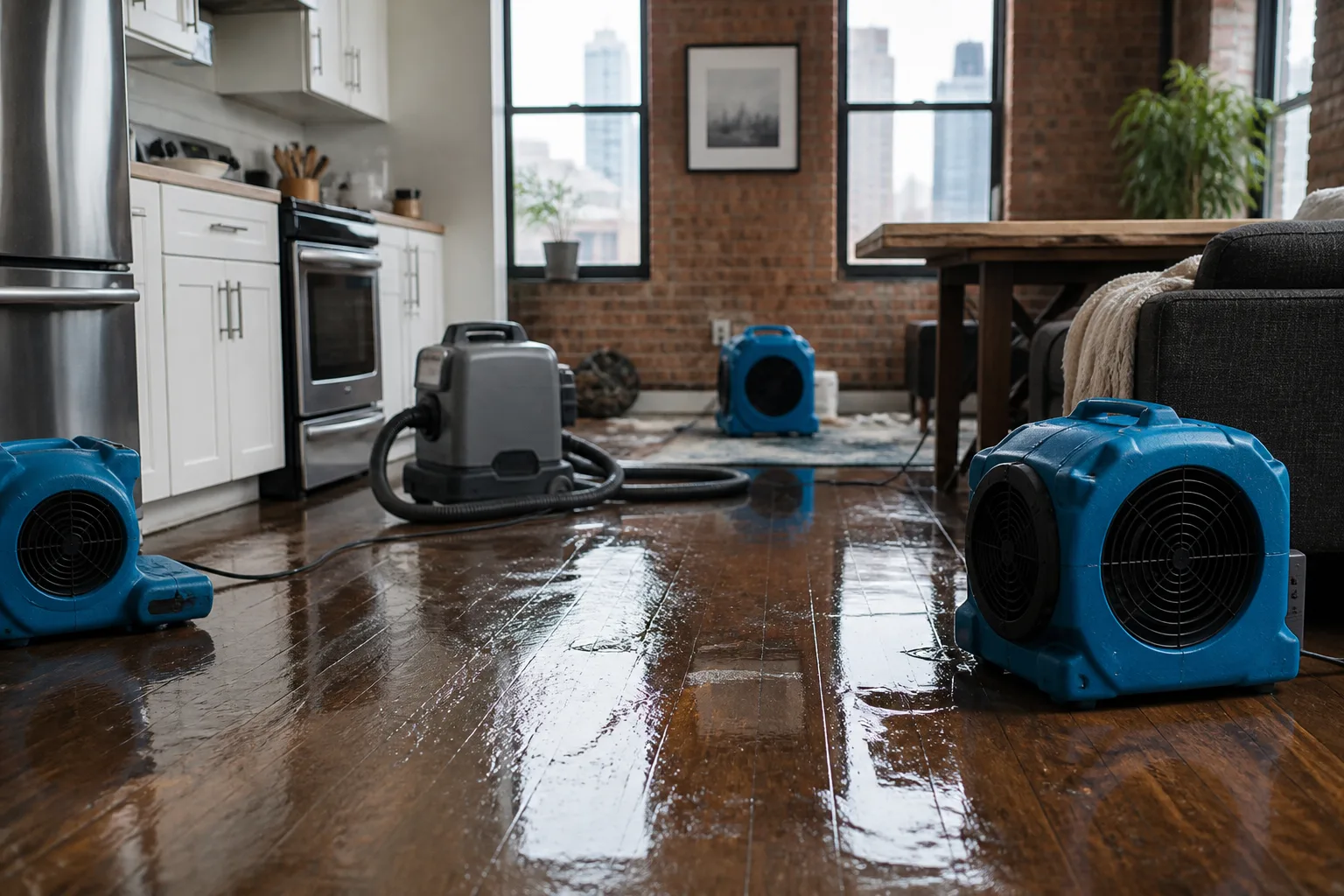
Emergency Water Damage Restoration Near Me: What Jersey City Homeowners Should Do First
If you’re standing in water in Jersey City right now, start by shutting off the water source if you can reach it safely, then call (640) 400-9404, a 24-hour restoration line answered by a live person. The first 90 minutes determine whether you’re facing a $4,000 dry-out or a $40,000 rebuild, because mold colonies can establish in porous building materials within 24 to 48 hours. If you’d rather not handle the first steps alone, we’ll walk you through them right now and be on-site before the water has finished finding its way into every seam of your floor.
We’ve spent over 42 years pulling water out of Jersey City homes, from brownstones in Van Vorst to garden units out by Lincoln Park. The calls that end with a simple dry-out share one thing: the homeowner made four or five smart moves in the first hour. The calls that end with gutted walls and a mold claim usually didn’t. This guide is the exact sequence we’d hand a neighbor, with the Jersey City specifics most generic articles skip.
Key Takeaways
- Your first call should be to a 24/7 restoration dispatcher, not your insurance carrier. Documentation matters more than a claim number in hour one.
- Jersey City MUA handles sewer backups; Hudson County OEM coordinates flood events. Know which to call.
- Never run fans into standing water or vacuum sewage with a shop vac. Both spread contamination.
- Photograph everything before you move a single item. Those photos are the basis of your entire claim.
- Condo owners, renters, and brownstone owner-occupants have different shutoff authority. Know yours before the water rises.
The First 90 Minutes: A Minute-by-Minute Sequence for Jersey City
The clock starts the moment you see water. Not when you call your spouse, not when you text your super. Mold doesn’t wait, and neither should you. Here’s the sequence that has saved Jersey City homeowners tens of thousands of dollars, and it’s built for the city’s specific building types, not a generic suburban checklist.
Minutes 0-5: Stop the source. If you’re a brownstone owner-occupant, you likely have a main shutoff valve in the basement, often near the front wall or under the stoop. Turn it. If you’re in a condo building, your unit may have a secondary shutoff behind an access panel in a closet or bathroom. If you can’t find it, call your building superintendent immediately. Renters should call the landlord or property manager, but don’t wait on hold: start the next step while the phone rings.
Minutes 5-15: Cut power where needed. If water has reached electrical outlets, appliances, or extension cords, turn off the circuit breaker for that area. Do not step into standing water to reach the panel if the water is already there. Call PSE&G or an electrician if you’re unsure. In Jersey City’s older brownstones, we often see panels in flooded basements, which is a genuine hazard, not a judgment call.
Minutes 15-45: Photograph and document. Pull your phone out. Take wide shots of every affected room from the doorway, then close-ups of baseboards, flooring, lower cabinets, and any visible water line. Open cabinets and photograph underneath sinks. If you have a water-damaged ceiling, photograph both the ceiling and the floor below it, because the damage pattern shows what the water traveled through. Do not move furniture, lift rugs, or wipe anything yet. The untouched scene tells the insurance adjuster exactly what happened and when, and it’s the strongest evidence you’ll ever have.
Minutes 45-90: Make the two calls. First, call a 24/7 restoration line that confirms a crew can be on-site, not just a call center that takes a message. Ask three questions: Can you dispatch a certified technician today? Will you document moisture levels with a written log? Do you bill the insurance carrier directly? If the answer to any of those is vague, call someone else. Second, call your insurance carrier’s claims line and tell them you have documented the scene and a restoration crew is en route. That order matters. Document first, then file the claim.
What Most Emergency Guides Get Wrong About Jersey City
The generic advice you’ll find online assumes you live in a single-family house with a garage and a sump pump. Most Jersey City homeowners don’t. They live in a 120-year-old brownstone split into condos, or a prewar rental off Journal Square, or a row house in the Heights with a shared party wall. The advice needs to change with the building type.
Condo owners: Your authority stops at your unit’s walls. You can’t shut off the building’s main water line without the board or super, and if the leak started in a neighboring unit or a common pipe, the building’s master policy may be primary. That doesn’t change your responsibility to mitigate damage in your own unit. Document everything, shut off your secondary valve if you have one, and notify the building management in writing, not just by phone. In our experience working in Jersey City condo buildings, the units that dry out fastest are the ones where the owner documented first and argued later.
Renters: Your legal obligation is to report water immediately to your landlord or property manager. Your renters’ insurance covers your personal belongings, not the building. Document your own items thoroughly before the landlord’s crew moves anything. A Jersey City tenant who photographs their flooded closet in Paulus Hook on day one has a far better claims outcome than one who waits a week to inventory what was lost.
Brownstone owner-occupants: You have full authority and full responsibility. If water is in your basement, shut the main valve and consider whether your circuit panel is in that basement. In brownstones throughout Downtown and Bergen-Lafayette, we routinely see panels mounted low on basement walls, exactly where flood water pools first. Cut power before it becomes a live electrical hazard.
The Jersey City Contacts You Actually Need
Here’s what the national articles don’t tell you: Jersey City has specific public agencies that respond to water emergencies, and calling the right one saves hours.
Jersey City Municipal Utilities Authority (Jersey City MUA) handles sanitary sewer backups and water main breaks. If sewage is backing up into your tub or floor drain, call their emergency line before you call anyone else. The MUA will determine whether the backup is on the city’s side or your property’s side, and that determination directly affects your insurance claim.
Hudson County Office of Emergency Management (OEM) coordinates flood response during storm events. If street flooding is backing into your basement or garden-level unit during heavy rain, report it to OEM. They track repeat-flood addresses and coordinate with city crews. This matters because a documented OEM report strengthens your insurance claim and, in some cases, opens the door to federal or state disaster assistance.
Your insurance carrier’s 24-hour claims line should be in your phone contacts today, not after the basement is full. Write it down. Tape it inside a kitchen cabinet. When water is rising at 2 a.m., you don’t want to be searching for a policy number on a waterlogged laptop.
Why a 24/7 Restoration Line Is Your Most Important Call
Here’s a truth most homeowners learn the hard way: the first restoration company you reach may not be the one that shows up. Some 24-hour hotlines route to an answering service that promises a callback within the hour. In a flooding event, that callback may come from a subcontractor who’s never seen your building, doesn’t know Jersey City’s permit requirements, and won’t be the one writing the moisture log your insurance carrier needs.
We built Floodline Restoration Co. home around a live dispatch board, not a sales desk, because timing is the entire job. When you call at 2 a.m., a real person answers in Jersey City. They confirm a certified crew’s availability, tell you who’s coming, and dispatch them that same visit. The technician who reads the moisture map on day one handles daily readings until the dry standard is met. That continuity isn’t a nice-to-have; it’s the difference between a verified dry-out and a hidden mold colony that surfaces six months later.
When you call any restoration company, including us, ask these three questions before hanging up: Is your technician IICRC-certified? Will I receive a written moisture log? Do you bill my insurance carrier directly? If the person on the phone hems and haws, you have your answer.
What Not to Do in the First Hour
Panic makes people reach for tools. Here are the four most common DIY mistakes we see in Jersey City homes, and they all make the job worse.
- Running box fans into standing water. Fans aerosolize water droplets, spreading bacteria and mold spores into the air and deeper into dry materials. Extraction comes first. Drying comes later, with containment.
- Using a shop vac on sewage-contaminated water. A standard wet-dry vac is not sealed for Category 3 water, which is what backs up from a sewer line. It spreads pathogens through the exhaust, and you’ll be breathing them. Sewage cleanup requires professional containment and disposal protocols.
- Pulling up soaked carpet and padding. If the water came from a clean source like a burst supply line, you might do more harm than good. If it came from a sewer backup or street flooding, you’re now handling contaminated material without protective gear. Leave it.
- Calling your insurance agent before documenting the scene. Your adjuster will ask what the damage looked like before anything was moved. If you’ve already pulled baseboards and dragged out a soaked drywall panel, you’ve destroyed the evidence that justified the claim. Photograph first, always.
One more thing most guides skip: do not use your home’s HVAC system if water has reached the unit or the return air ducts. Forced air will distribute contaminants through every room. In Jersey City’s older homes, the return air often pulls from the basement, exactly where water collects.
How to Document the Scene for Insurance, Step by Step
Your camera roll is the single most valuable tool in your entire claim. Here’s the method we teach Jersey City homeowners, and it applies whether the water came from a broken water heater in Greenville or a Nor’easter that pushed street water into your garden apartment in the Heights.
- 1
Wide shots first. Stand in the doorway of each affected room and photograph the entire space before moving anything. This establishes scope.
- 2
Water lines. Photograph the visible water line on walls, baseboards, and furniture. That line is physical evidence of how much water entered and how long it sat.
- 3
Source of the water. If a pipe burst, photograph the pipe and the fitting that failed. If it’s a sewer backup, photograph the floor drain. If it’s street flooding, photograph the exterior water level against your building.
- 4
Contents in place. Photograph furniture, rugs, electronics, and personal items exactly where they sit. Do not lift, move, or wipe them.
- 5
Serial numbers and receipts. For any significant appliance or electronics item, photograph the serial number plate and any receipts or manuals you still have. This speeds up the valuation conversation.
- 6
Time-stamp everything. Use your phone’s timestamp feature or hold up a current newspaper in one photo. It feels old-fashioned, and it works.
This documentation becomes the foundation of your entire claim. When our Water Damage Restoration in Jersey City team arrives, we add professional-grade moisture mapping with Dri-Eaz and Phoenix equipment, daily readings that go into a written log, and direct communication with your adjuster. But the scene as you first found it? That’s yours to capture, and it’s worth more than any technician’s report when the adjuster asks questions weeks later.
We pulled one job out of a garden unit over near Riverview-Fisk Park last month where the homeowner had photographed everything, down to the water line on her mother’s hope chest. Her adjuster approved the claim in four days, no back-and-forth. The neighbor two doors down had moved everything to “save it” and spent three weeks arguing about what had actually been damaged. The photos are the claim.
When to Call a Pro
Some Jersey City water events are genuinely manageable on your own. A slow drip under a kitchen sink with a caught bucket? Fix the fitting, dry the cabinet interior, move on. But if you answer yes to any of these, call a professional right away:
- Water has soaked into drywall, baseboards, or laminate flooring for more than a few hours.
- The water source is a sewer backup, toilet overflow, or street flooding.
- Water has reached electrical outlets, appliances, or your breaker panel.
- The affected area is larger than a single room.
- You smell a musty odor that appeared within a day of the water event.
If any of those apply, call (640) 400-9404. A live dispatcher answers, and a certified technician will be on-site the same visit. We’ve been doing Mold Remediation in Jersey City and water extraction long enough to know that the jobs we see on day one are a fraction of the cost of the ones we inherit on day ten.
Related Services in Jersey City
Water damage rarely travels alone. If your water event involved a fire suppression system or resulted in smoke damage, Fire & Smoke Damage Restoration in Jersey City follows the same documented, single-crew approach. And if you’re reading this two weeks after the water receded and you’re noticing a musty smell, our mold remediation team uses the same moisture-mapping protocol to find what’s hiding behind the drywall.
What happens when you call
- 1
A real person answersNo phone trees - you reach a local pro.
- 2
You get an upfront price rangeHonest numbers before anyone is dispatched.
- 3
A background-checked tech heads outLicensed & insured, dispatched right away.
- 4
You approve before work beginsNothing starts until you say go.
The Bottom Line
The first 90 minutes are the only window where your actions meaningfully change the outcome. Shut off the source if you safely can. Cut power where water has reached electrical systems. Photograph everything before you move a single item. Then call a 24/7 restoration line with a live dispatcher and ask the three questions: certified technician, written moisture log, direct insurance billing. If you’re in Jersey City and need help, Floodline Restoration Co. offers free estimates, same-visit crew dispatch, and the 90-Day Done Right Promise in writing. Call (640) 400-9404 and a real person picks up, day or night.
Frequently Asked Questions
A 24/7 restoration company with live dispatch, like Floodline Restoration Co., can typically have a certified technician on-site the same visit you call, including nights and weekends. The important question to ask the company is whether a real crew will arrive versus an answering service that promises a callback. We dispatch from Jersey City, not a call center in another state.
Most homeowners policies cover sudden and accidental water damage, like a burst pipe or an overflowing washing machine, but not gradual leaks or neglect. Sewer backup coverage is often an add-on endorsement. Your documentation, photographs, and a professional moisture log are what get your claim approved. We bill insurance carriers directly and handle the adjuster communication so you’re not playing messenger.
If water has soaked into drywall, flooring, or baseboards, professional drying is necessary. Consumer-grade equipment doesn’t have the airflow or the low-grain refrigerant dehumidification needed to pull moisture from structural cavities. We use Dri-Eaz, Phoenix, and XPOWER equipment with daily moisture readings, recorded in a written log, until the dry standard is met. That log is what proves to your insurer the job was done correctly.
Call your building superintendent or property management immediately, and document that call in writing. While you wait, photograph the damage, start moving unaffected valuables to higher ground, and call a restoration dispatcher who can be on standby. Condo owners in Jersey City should also review their building’s master policy, because leaks from common pipes may be covered under a different policy than your own. Don’t make assumptions about who pays; document and call.
Written by Curt Bowman, Owner at Floodline Restoration Co., serving Jersey City since 2010.
Need Damage Restoration Help?
Call Floodline Restoration Co. - licensed & insured, here with fast after-hours help in Jersey City.
(640) 400-9404