
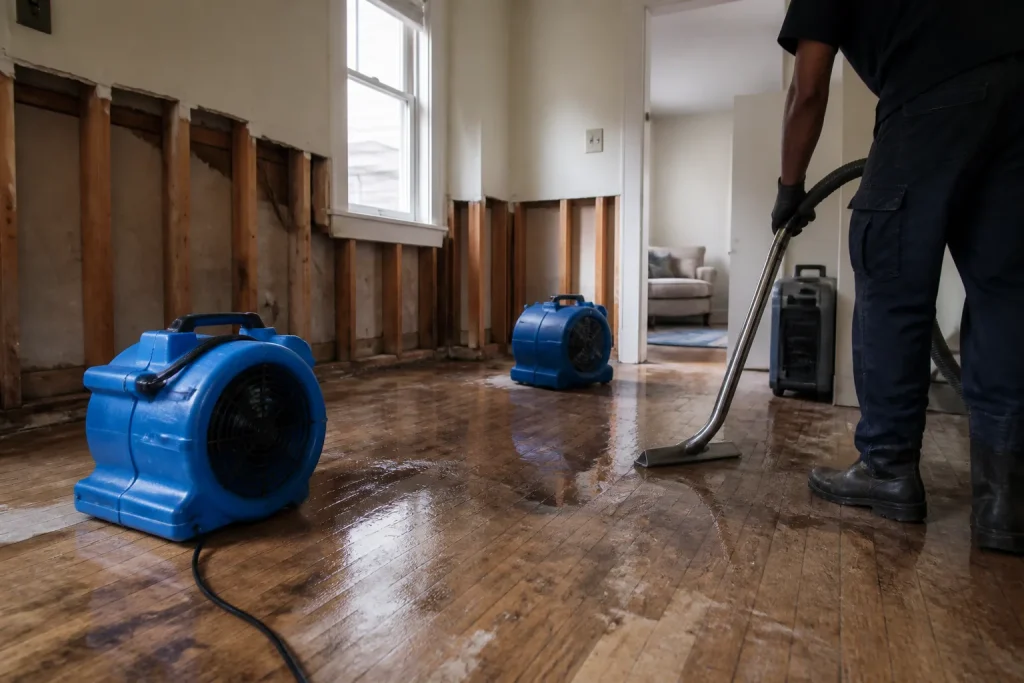
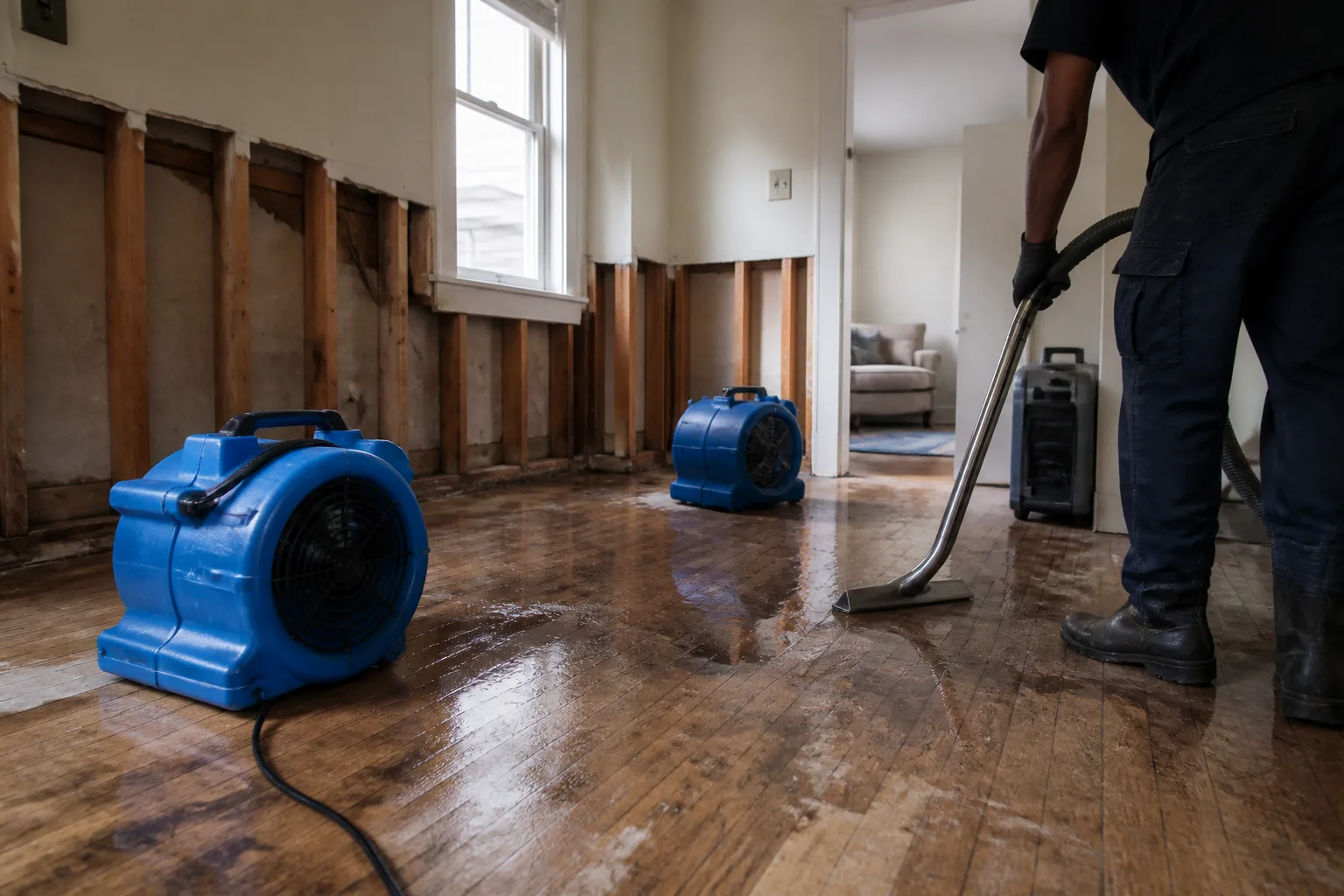
Water Damage Restoration What It Really Costs: What Jersey City Homeowners Pay in 2026
In Jersey City, water damage restoration runs anywhere from $1,200 for a small Category 1 leak to $25,000+ for a sewage backup that hits finished rooms and shared walls. The number that ends a job, though, is almost never the number on the first estimate. Three predictable line items drive most of that gap: hidden mold behind plaster, asbestos tile in pre-1980 buildings, and structural damage hiding in shared walls. If you know those before work starts, you control the final bill. If you’d rather not manage the details, call Floodline Restoration Co. home at (640) 400-9404 and we’ll walk the job with you.
Key Takeaways
- Category 1 water costs $3.50-$7.00 per square foot in Jersey City; Category 3 sewage or backup water runs $7.00-$12.00 per square foot after containment and disposal.
- The average Northeast water claim gets adjusted downward 22% at first review, and the single best counter is a detailed moisture log and photo-documented scope.
- Three change orders show up in most Jersey City restorations: mold in plaster walls, asbestos floor tile in pre-1980 units, and shared-wall structural repair.
- A split-contractor model (separate mitigation and rebuild invoices) typically costs 15-25% more in total than a single-scope contract.
- The 90-Day Done Right Promise puts the post-completion risk on the contractor, not the homeowner, and that difference is worth real money when comparing bids.
What Actually Drives the Cost in Jersey City
The single biggest factor is the water category, and Jersey City’s housing stock makes the category matter more than it does elsewhere. A supply-line break feeding clean water into a dining room is a Category 1 job: extraction, drying, maybe some baseboard and drywall. A toilet backup that sat overnight is Category 3, which requires containment, disposal of porous materials, and antimicrobial treatment under IICRC standards. That’s not a minor paperwork distinction. It changes the labor hours, the equipment count, and the disposal fees.
Here’s what we see in Jersey City across 2025 into 2026:
- Category 1, under 200 sq ft: $1,200-$3,000. Typical scenario: a supply line fails in a second-floor bathroom, water runs down through the dining room ceiling.
- Category 1, 200-600 sq ft: $3,500-$7,500. Finished basement with drywall, baseboard, and flooring affected. Drying takes four to seven days.
- Category 2 (gray water), any size: $5,000-$11,000. Washing machine overflow or dishwasher failure. Carpet, pad, and lower drywall usually come out.
- Category 3 (sewage or flood water), 200-600 sq ft: $8,000-$18,000. This is the one most people under-insure for. It’s also the one where cutting corners costs the most later.
- Full basement or multi-room sewage: $18,000-$30,000+. Especially in brownstones and pre-war buildings where shared walls and old framing complicate containment.
Jersey City’s labor costs sit above the national average, driven by the same market forces pushing every trade in Hudson County. Material costs for LVP flooring, drywall, and trim landed higher in 2025 than most homeowners expect. And when you’re in a multi-unit building, the containment and access requirements add a layer most national cost calculators never factor. If you’re comparing bids, ask one question: does this price include daily moisture readings and a written dry standard, or does the crew disappear after the fans go in? The answer tells you everything.
The Three Change Orders You’ll See Coming
Most contractors do not include these in the first scope. Not necessarily because they’re hiding them, but because they don’t reveal themselves until the drywall comes off and the space is opened. The problem is that in Jersey City, these three are predictable enough that a competent restoration company should flag them as likely, not possible.
1. Mold Behind Plaster
Plaster walls are standard in a huge share of Jersey City homes, from the Heights to Greenville to Bergen-Lafayette. Plaster holds moisture differently than drywall. It wicks. So water that ran down an interior wall into a baseboard two days before you noticed has likely created conditions where mold gets a toehold inside the plaster keys, behind the lath. That mold doesn’t show on the surface for weeks. It shows up when the restoration crew opens the wall for drying. At that point the job scope changes: containment goes up, the affected lath comes out, and the crew transitions from water damage to Mold Remediation in Jersey City protocols. That change order typically lands between $1,500 and $6,000 depending on the square footage and whether the mold has entered any wall cavities beyond the original wet patch.
You cannot avoid this one entirely. You can prepare for it. A good initial scope includes a line item for “anticipated wall cavity inspection with contingency for mold remediation.” If a contractor’s bid doesn’t mention it, ask.
2. Asbestos Floor Tile in Pre-1980 Units
Jersey City has thousands of pre-1980 buildings, and many still have the original 9×9 vinyl asbestos tile somewhere under a newer floor. When water damage requires pulling up flooring in those units, that tile has to be tested before it’s disturbed. If it tests positive, you’re now dealing with abatement requirements: containment, licensed handlers, special disposal. That’s not a restoration line item, it’s an abatement line item, and it can add $2,000 to $5,000 on a single room. Some restoration companies don’t flag it because they don’t test. Then tile is pulled, disturbed, and now you have a larger problem. The right move is to test before demo. A reputable company includes that in the scope from day one.
3. Secondary Structural Damage in Shared Walls
This is the brownstone and attached-rowhouse problem. Water doesn’t respect your property line. A leak in your ceiling from a neighbor’s pipe means the framing in that shared wall has been wet longer than your finishes have been wet. The visible damage might be drywall and paint. The structural reality might be rotted sill plates or rim joists that need replacement. In Jersey City, attached single-family homes make this common enough that it should be in every initial assessment. Repairing shared-wall framing can run $3,000 to $10,000 depending on access and load-bearing conditions. The only way to know before the work starts is a proper moisture map and an experienced eye. That’s why we send technicians who know what old Jersey City framing looks like, not just what a drywall patch looks like.
What Direct Insurance Billing Actually Looks Like
Here’s where a lot of homeowners lose money without realizing it. Most restoration companies will tell you they “work with insurance.” That phrase covers a lot of ground. Direct billing is different. It means the restoration company documents the loss, completes the work, and bills your carrier directly for covered items. You’re not fronting $12,000 and hoping for reimbursement. You’re not the messenger between two parties arguing about line items.
The documentation is the part that matters. Before the adjuster’s first site visit, a homeowner should demand these from their contractor:
- A photo-documented scope of loss with every affected room, wall, and floor captured before demolition.
- A moisture map taken on day one showing the initial readings in each affected area.
- A daily moisture log updated until the dry standard is met, not just “everything looks dry to me.”
- A written estimate with line-item pricing using Xactimate or a similar industry-standard software, so the carrier can review it line by line.
- Direct communication with the adjuster from the restoration company, in writing, with the homeowner copied.
When that documentation is solid, the adjuster has what they need to approve the full scope. When it’s thin, the carrier’s first offer is lower, and the homeowner ends up negotiating from a weak position. We’ve seen the difference on Water Damage Restoration in Jersey City jobs where the adjuster approved everything in a single review because the file was complete from day one. That’s the point of the paperwork.
Split Contractor vs. Single-Scope: The Pricing Gap
Most water damage restorations involve two phases: mitigation (extraction, drying, demo of unsalvageable materials) and rebuild (drywall, flooring, paint, trim). The traditional model in this industry splits those phases between two companies. A mitigation company comes in, dries everything, leaves, and a general contractor handles the rebuild. Two invoices, two overhead structures, two profit margins, and a gap in accountability when something goes wrong between the phases.
Here’s what that actually costs you. The mitigation company prices its scope without knowing what the rebuild will require. The rebuild contractor prices their scope without knowing what the mitigation crew actually did. When a gap shows up, it’s a change order. In our experience, the split model runs 15 to 25 percent higher on the final bill than a single-scope contract, because every handoff between companies is a place where scope creep can attach itself.
A single-scope contract means one company handles extraction through rebuild. One invoice, one project lead, one warranty. The cost savings come from removing the second overhead layer and the handoff markup. The bigger value is that the same crew that took the moisture readings on day one is the crew doing the final walkthrough. That continuity is not a nice-to-have. When something goes wrong, there’s one name to hold accountable, and the argument about which contractor was responsible disappears.
Ask about this before you sign anything. “Who does the rebuild?” If the answer is a different company, ask how the handoff works and who’s responsible if the rebuild fails because the drying was done wrong. That conversation alone can save you thousands.
What the 90-Day Done Right Promise Is Worth
Most restoration guarantees are soft. “We’ll come back if you notice a problem” is not a guarantee, it’s an invitation to argue. The 90-Day Done Right Promise is a written commitment: if the work isn’t done right, we make it right. No paperwork battle, no “that’s outside the original scope” conversation. It’s a specific window of time during which the contractor, not the homeowner, carries the risk of a bad dry-out or a faulty rebuild.
In dollar terms, a written post-completion guarantee changes the risk calculation on a $10,000 to $30,000 project. If a bad drying job leads to mold two months later, and you accepted a bid without a guarantee, that remediation is on you. If a guarantee is in writing, that remediation is on the contractor. That difference is worth real money. When you’re comparing bids, ask for the guarantee in writing before you sign, and read what it actually covers. A company that won’t put it in writing is telling you something about how they’d handle a problem six weeks out.
We’ve been at this in Jersey City since 2010. The houses are old, the water events are frequent, and the same three change orders show up over and over in the Heights, in the Ward, and down by the waterfront. We plan for them from day one and write the scope accordingly. The line the water left is where we start, and we don’t hand the job off until the baseboards are back and the paint is dry.
Related services in Jersey City: if your water damage has sat wet for more than 48 hours, the mold conversation matters. Read Mold Remediation in Jersey City for what happens next. And if the damage started as a fire suppression event, Fire & Smoke Damage Restoration in Jersey City walks through the combined restoration process.
When to Call a Pro
If the water touched anything beyond a single room with clean water and you caught it within the hour, a restoration company can handle the job faster than you can rent equipment. Here’s the moment to stop and call:
- Water has been sitting more than 24 hours.
- Water came from sewage, a toilet, or an outside flood.
- Water has reached drywall, baseboards, or finished flooring.
- You smell anything musty or the air feels damp days later.
- Your walls are plaster and you can see the water line.
We pulled one out of a shared-wall row house over in Bergen-Lafayette last month where the homeowner had been running box fans for three days. The drywall felt dry to the touch. The moisture meter told a different story behind the plaster, and the framing had been holding water the whole time. That’s the difference between guessing and measuring. Our technicians use Dri-Eaz, Phoenix, and XPOWER equipment, and we log readings daily until the dry standard is actually met, not until it looks dry. If you’re in Jersey City and water’s been in your house longer than a day, call (640) 400-9404 and a live person will answer, no matter the hour.
The Bottom Line
Water damage restoration in Jersey City costs between $1,200 and $30,000 in 2026, depending almost entirely on water category and square footage. The final bill usually lands higher than the first estimate because of hidden mold, asbestos tile, and shared-wall structural work, and you control that gap by knowing the questions to ask before you sign. Demand documentation, choose a single-scope contractor, and get your guarantee in writing. A square deal means no surprises on the bill, and that’s the only way the numbers on paper mean anything.
If you’re in Jersey City and need help, Floodline Restoration Co. offers free estimates. We answer the phone with a person, we bill your carrier directly, and we stand behind the work in writing. Call (640) 400-9404.
Frequently Asked Questions
Most homeowners pay between $1,200 and $30,000 depending on the water category, square footage, and whether the building is a single-family home or a shared-wall attached unit. Category 1 clean water jobs typically run $3.50 to $7.00 per square foot, while Category 3 sewage jobs run $7.00 to $12.00 per square foot after containment and disposal. Call (640) 400-9404 for a free estimate on your specific situation.
Most homeowner policies cover sudden and accidental water damage from supply lines, appliance failures, and storms, but they often exclude or limit coverage for gradual leaks, neglect, or groundwater flooding. Flood damage requires a separate flood insurance policy. The documentation your contractor provides before the adjuster’s first visit is the biggest factor in what the carrier ultimately pays.
In Jersey City, response time depends on the company. Floodline Restoration Co. has live dispatch 24/7, and a certified crew reaches the job with extraction equipment running the same visit. The faster extraction starts, the less the damage spreads into framing, flooring, and wall cavities.
If the water was clean, the affected area was small, and you caught it within a few hours, a targeted extraction and drying may be all you need. If the water sat overnight, came from a toilet or sewage line, or reached drywall and flooring, full restoration is the safer path. Cleaning alone leaves moisture in places you cannot see, and mold follows within two to three weeks. Call (640) 400-9404 and we’ll tell you honestly which category you’re in.
Written by Curt Bowman, Owner at Floodline Restoration Co., serving Jersey City since 2010.
Need Damage Restoration Help?
Call Floodline Restoration Co. - licensed & insured, here with fast after-hours help in Jersey City.
(640) 400-9404